All About Prismatic Ray
Category: Legacy Docs · Tags: eurorack, expedition, prismaticray · Posts: 1
#1 — Z0NK0UT · 2019-07-19
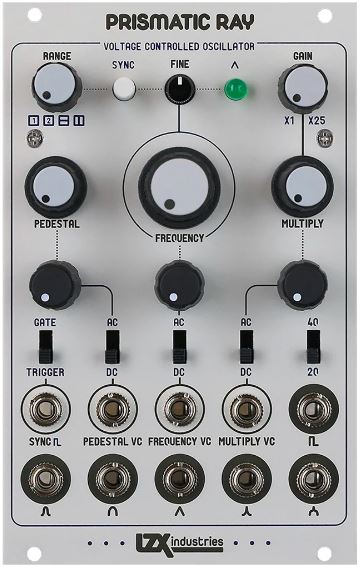
Prismatic Ray is a reference to the mid-century fantasy fiction of Jack Vance, and to the tabletop roleplaying games inspired by it. It is a magic spell which blinds ones opponents with searing rays of multi-colored light. Your video synthesis projections likely accomplish the same effect, if you perform live with your video synthesizer.
VCOs are an essential building block of both audio and video synthesis, and a stable, highly usable wide frequency range VCO core was one of the first items on our to-do list as we began developing video synthesis circuitry. Prismatic Ray represents the latest evolution of our video VCO design, also seen in the Video Waveform Generator module and earlier prototypes.
With Video Waveform Generator, we followed a design inspired by audio oscillators: Sine Shape and Pulse Width modulation had dedicated control circuits and independent outputs. In Prismatic Ray, I wanted to make these features more molded around the needs of a visual synthesizer. To that end, rather than having separate PWM and Sine shape modulators, we have an offset (Pedestal) and amplitude modulation (Multiply) section, and a high gain amplifier, in the signal path between the VCO core and ALL of the output wave shapers. Modulation of these parameters now happens to all output wave shapes simultaneously, and the high gain control allows for a smooth interpolation between gradual slopes or hard edged pulses. We’ve also introduced 4 quadrant multiplication as a feature, which allows the inversion of the output wave shape to be a function of voltage control! This allows XOR-style pattern making without the
need for external logic circuitry.
Prismatic Ray is the next generation of the LZX Industries analog widerange Voltage Controlled Oscillator design. With a max frequency range into the megahertz and hard sync input with phase stability, it is uniquely qualified for video synthesis techniques. In many VCO designs, modulation of waveform shape is achieved after the oscillator core, with modulation over output wave shaper circuits. In this design, we place modulation in the core of the oscillator itself, allowing complex summing, linear key generation, multiplication and inversion to affect all the output wave shapes simultaneously. When multiple wave shapes are patched to different color channels, the prismatic nature of this module begins to emerge.
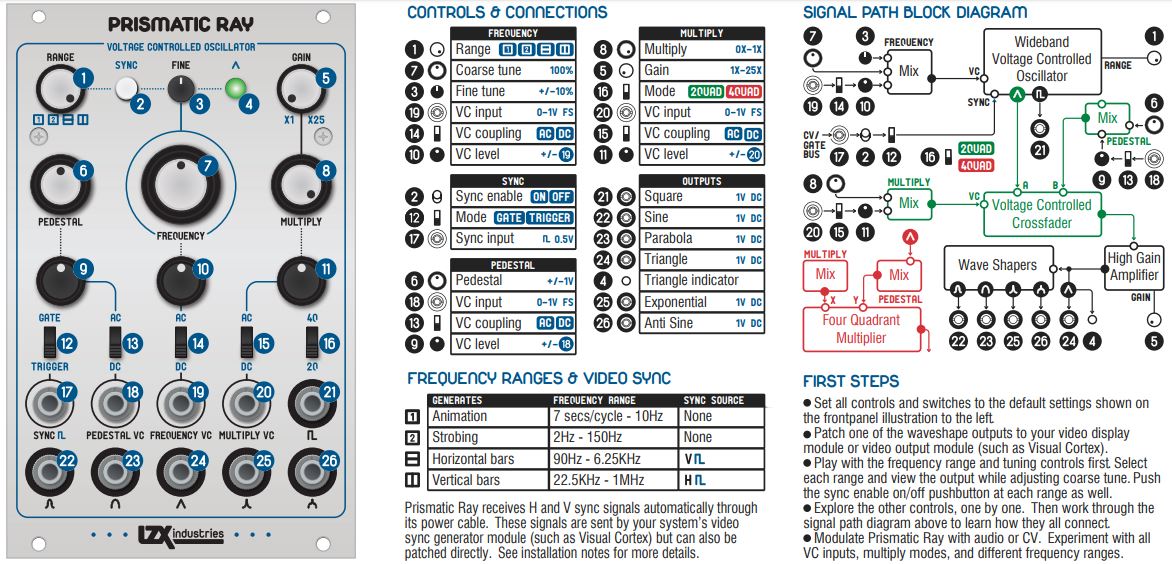
- Coarse & Fine tuning controls for oscillator frequency. Frequency Modulation voltage control input with dedicated level and inversion control.
- Simultaneous Triangle, Square, Sine, Anti-Sine, Exponential and Logarithmic waveshape outputs.
- VCO core multiplier with dedicated level control and voltage control input. High gain amplifier control enables fluid morphs between hard and soft edged waveshapes. In 4 Quadrant mode, the output waveshapes can be inverted under voltage control.
- VCO core bias level control and voltage control input allows control over the relative brightness of all the output waveshapes. With other patterns or video as a modulation source, the bias input allows this module to function as a powerful external slope and key processor for any video signal.
- All signal and control paths perform at high frequency, video rate modulation speeds.
- AC/DC input coupling switches and inverting level attenuators on voltage control inputs.
Specifications
- Width, 16HP
- Mounting Depth, 32mm
- Power +12V @ 120mA
- Power -12V @ 90mA
User Reference
Videos
https://www.youtube.com/watch?v=sgnpVI9qPVo
Patching Tips
- Use mults to send the same modulation source to multiple VC inputs at once. Use mixer modules (like Passage or Bridge) to mix together many modulation sources.
- Feed different output wave shapes to RGB color channels simultaneously, to create subtle gradients.
- Instead of modulating the frequency CV input, explore the visual differences of modulating Pedestal and Multiply instead.
- Play with the gain control for more pulse-width modulation based responsiveness from pedestal modulation.
- Explore 4 quadrant and 2 quadrant modes, with and without modulation. These modes change the functions of Multiply and Pedestal.
- Try using external audio and video images as modulation sources. Play with all the frequency ranges while doing this.
- Try patching a 2D shape or external camera image into the sync input.
- In 2 quadrant mode, with Multiply fully counter-clockwise and Pedestal centered, patch an external signal into the Pedestal VC input. Put the Pedestal VC level control fully clockwise. You are now processing the external signal through all of Prismatic Ray’s output wave shapers and high gain amp, with the internal VCO fully suppressed.
- By patching the Anti-Sine/Sine or Exponential/Parabola outputs into the A/B inputs of a crossfader module, you can control the crossfader to get a wave shape morph. The center position of the crossfader (both inputs at 50%) will give triangle output. Combined with the technique for external processing described above, you can achieve gamma and gray level expansion/compression when your source is a video image.