All About Sensory Translator
Category: Legacy Docs · Tags: eurorack, expedition, sensorytranslator · Posts: 13
#1 — Z0NK0UT · 2019-07-22
https://lzxindustries.net/products/sensory-translator
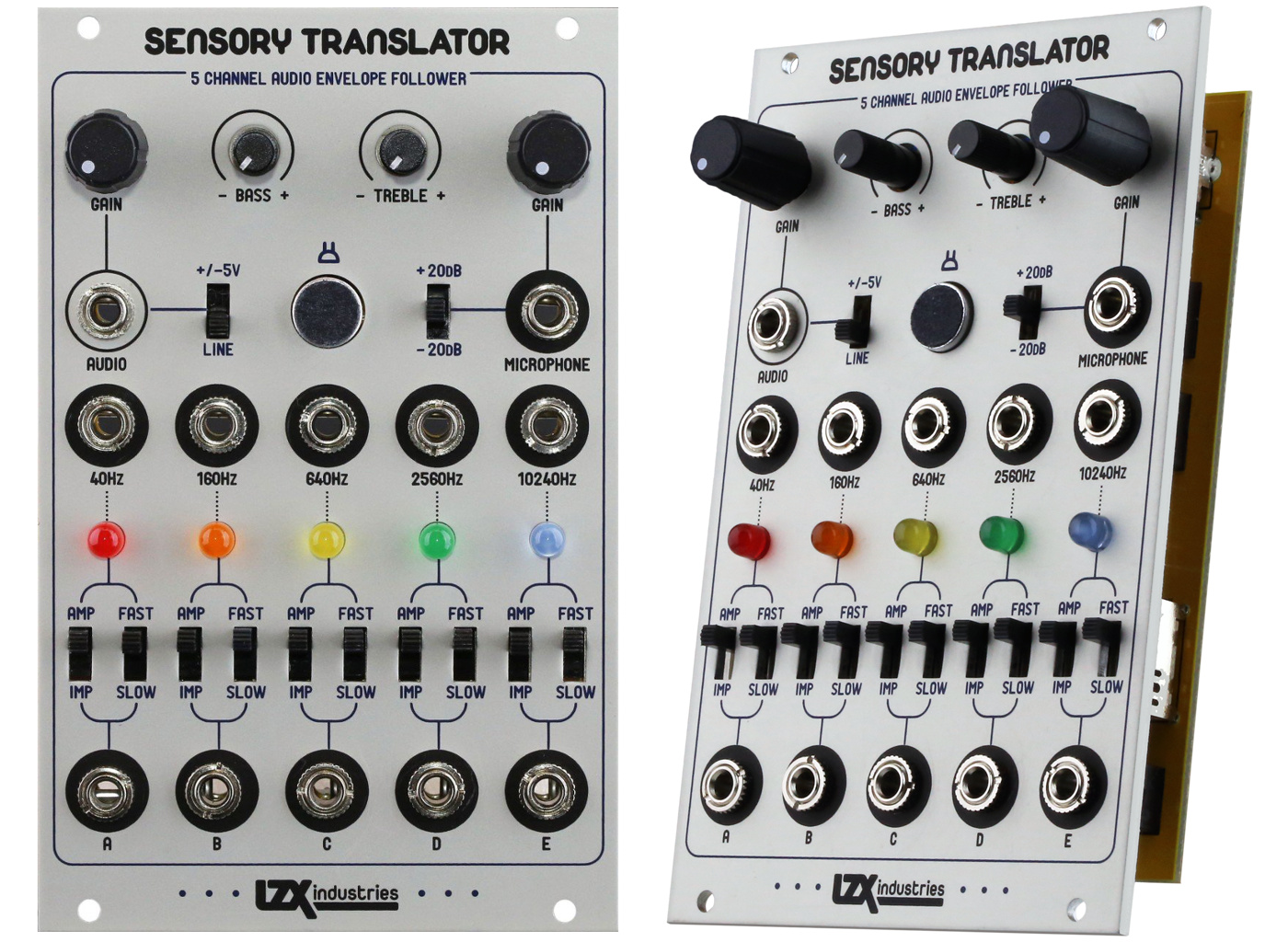
The Sensory Translator is a five-channel envelope follower module. Since each of the module’s channels is essentially a band-passed frequency band, the resulting control voltage evolves from the volume of each band. Use the external audio input, microphone, or both at once to turn the sounds around you into five channels of CV control over your patch. Listen to the room. The Sensory Translator comes equipped with an omnidirectional microphone that can hear more than you can!
- The Microphone output provides a modular level signal from the on-board mic.
- The +/- switches are for adjusting/boosting the input gain.
- The upper row of outputs give you individual filtered frequencies of the incoming audio.
- The bottom row of outputs are separate envelope signals for each of the frequency bands.
- The Amp/Imp switches select between an envelope output (Amp), or a trigger output (Imp for Impulse).
- The Fast/Slow switches control the response/slew of the envelope.
Specifications and Features
- Omnidirectional electret microphone mounted on front panel
- Three preamp gain settings
- External audio input selectable between line and modular level voltages
- 2-input mixer including EQ with Bass and Treble levels
- Five 4-Pole precision bandpass filters
- Each bandpass filter has a 2-Octave bandwidth
- Five envelope followers with three decay speed settings
- Dedicated LED indicators for each channel
- Selectable Impulse mode for Beat-to-Trigger detection
- 16 HP
- 80 mA +12V 70 mA -12V
Videos
Other Resources
#2 — vhsdestroyer · 2022-03-01
Hey @Z0NK0UT Is the wave shape of envelope in AMP mode? Sine, Triangle, Etc.
#3 — Z0NK0UT · 2022-03-01
The shape of the envelope is devised from the amplitude of the incoming signal.
#4 — Dr_Rek · 2022-03-01
I was wondering how one might use the +/-5v audio input? Would that be CV or? I’ve only used LINE so far.
#5 — Z0NK0UT · 2022-03-01
Useful if you want to come straight out of audio modules without going down to line level first.
#6 — Dr_Rek · 2022-03-01
Ah nice, I’ve been mostly avoiding audio modular, too never ending on the GAS scale, but good to know if I do use some of my audio modules / semi modular synths with it sometime.
#7 — vhsdestroyer · 2022-03-01
Okay good to know, I’m looking to pair another module with sensory translator to accelerate the curve from AMP mode. Some kind of waves shaper or slew limiter so there is an exaggeration from the 1V ping and all lower voltages.
#8 — Z0NK0UT · 2022-03-02
Sensory Translator has slew control and wave shape built in, with the IMP/AMP and Fast/Slow switches. If those settings do not serve your use case, you can always set it to IMP + Fast and trigger a separate envelope generator or slope.
#9 — Genlok · 2022-03-08
Is there any purpose behind the specific frequencies chosen for the 5 bands? 40, 160, 640, 2560, 10240
#10 — phosphenes · 2022-03-08
I’d assumed it was to roughly centre around kick frequencies at 40Hz, snares at 160Hz and then higher frequency bands being separated by 4x the previous to give enough isolation between each band as each filter is 4 pole with a two octave bandwidth.
#11 — jwsmithwick1 · 2022-03-08
… cymbals and hats in the upper frequencies as well as cowbell/clave.
#12 — Genlok · 2022-03-08
phosphenes wrote:
higher frequency bands being separated by 4x the previous to give enough isolation between each band as each filter is 4 pole with a two octave bandwidth
Ah, this makes a lot of sense