Recommendations/sources for video cables and patch cables
Category: Unknown · Tags: — · Posts: 55
#1 — creatorlars · 2018-07-21
Post your good and bad experiences with various cables and sources to purchase them.
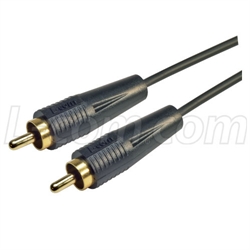
I’ll start! My favorite RCA cables for video synths are the Thinline brand, available in 1/5/10/15/20/25 ft lengths from L-Com. They are very high quality, proper 75 ohm impedance for professional video, and have a thin flexible cable similar to minijack patch cables.
#2 — creatorlars · 2018-07-21
#3 — 337is · 2018-07-21
I use the LZX/Blackmarket cables which come in 5, 12, and 24 inch lengths. They’re particularly useful for setting up multi-Vessel systems:
https://www.lzxindustries.net/shop/product/rca-sync-cable-3014
I’ve also had good luck so far with these from Amazon:
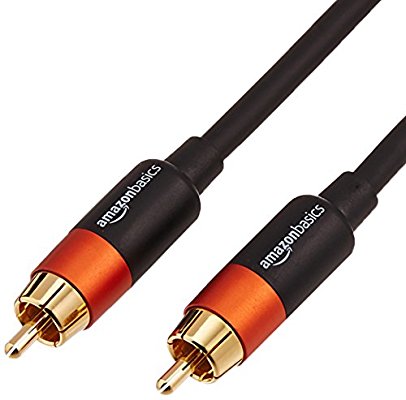
https://www.amazon.com/gp/product/B01D5H8TS4/ref=oh_aui_detailpage_o01_s00?ie=UTF8&th=1
An Amazon Brand.
Link: Amazon.com: AmazonBasics Digital Audio Coaxial Cable - 4 Feet: Electronics
They come in 4, 8, 15, and 25 foot lengths.
#4 — Travis · 2018-07-22
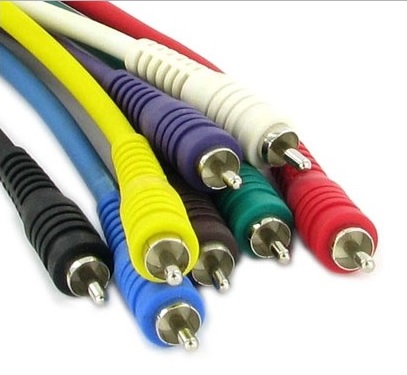
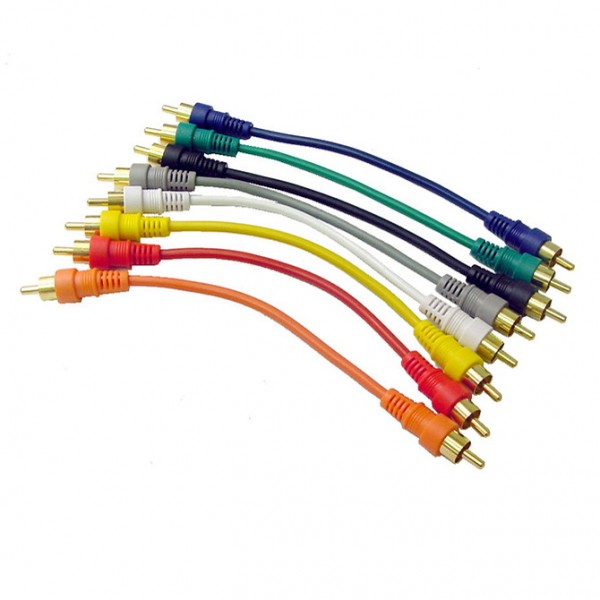
I got some coloured RCAs from Selbys, they have a nice soft feel to them and they come in short sizes as well as others. Build quality seems fine and the colours are helpful in a nest of cables. https://www.selby.com.au/8-pack-of-30cm-selby-rca-to-rca-plug-cables-ap2432-30cm.html
#5 — JunkRhythm · 2018-07-22
I stumbled upon Calrad products at Ametron in Los Angeles and they have been flawless so far.
55-875-6 - 6ft Shielded BNC to RCA (75 Ohm) 55-875-12 - 12ft Shielded BNC to RCA (75 Ohm)
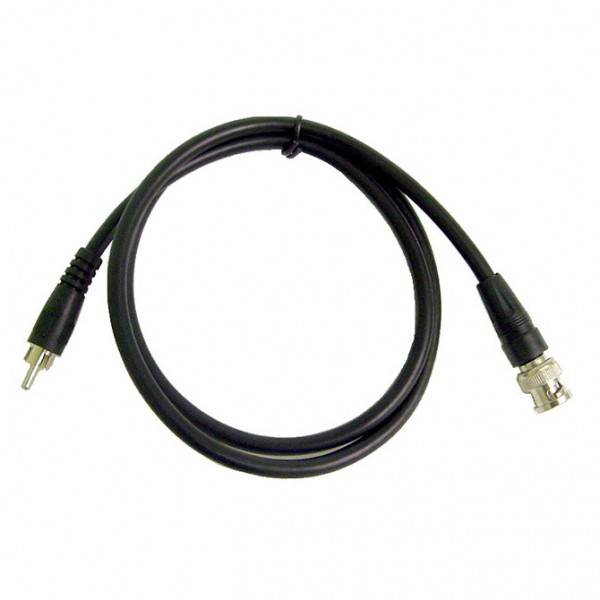
55-750G - 6in RCA Male to RCA Male Multi Colored Shielded Patch Cable 55-751G - 1ft RCA Male to RCA Male Multi Colored Shielded Patch Cable 55-753G - 2ft RCA Male to RCA Male Multi Colored Shielded Patch Cable 55-754G - 3ft RCA Male to RCA Male Multi Colored Shielded Patch Cable
#6 — creatorlars · 2018-07-22
@JunkRhythm those RCAs look amazing!!!
#7 — anomad · 2018-07-28
. i have four sets of the 3’ cables - solid feel and the plugs are snug but not tight on equipment. i’m glad you posted this b/c i forgot where i got them from!

#8 — destroythings · 2018-08-23
I ended up buying some of these Amazon basics component + audio cables and just cutting out the audio cables.

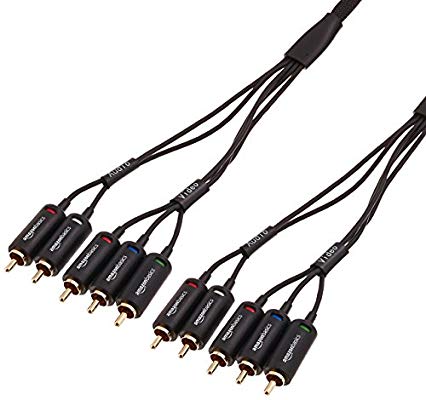
An Amazon Brand.
Link: Amazon.com: AmazonBasics RCA Component Video Cable with Audio - 6 Feet:...
#9 — brendanleespengler · 2018-08-28
I’ve got a cable question regarding the Andor. I purchased what I thought was a replica of the cable that came with my friend’s deeluxe Andor for running the Andor into the Visual Cortex. The one posted below, however, does NOT sync w the VC as the one that comes w the deeeeluxe Andor. Does anyone who’s bought the plain old pedestrian Andor know where to source a reliable 3.5mm AV mini-plug to RCA cable?
Cmple - 3.5mm to 3 RCA Camcorder Video Audio Cable - 6 ft https://www.amazon.com/dp/B000KW6VJ2/ref=cm_sw_r_cp_api_p7DHBbZ3YKA79
#11 — brendanleespengler · 2018-08-29
Easy fix! I forgot where I read this, maybe via LZX, but I tried the red RCA, rather than the yellow as we would assume. The Andor synced immediately to the VC.
#12 — paulslocum · 2018-08-29
@DesertMuseum Regular 3.5mm stereo audio-only cables do work with the Andor 1, although there is a bug that causes analog audio to not work when the Andor 1 is used with some HDMI monitors (a fix for this is coming in the next week or two).
As far as analog audio/video breakout cables, that Zune cable you linked is one I would recommend. I have one here and it works great.
There are a lot of different wirings for those red/white/yellow 3.5mm breakout cables. Some work as expected, some have the video and audio switched, and some don’t work at all. Generally cables that say they are for the “Zune” or “iPod” will work.
#14 — northerntao · 2018-11-19
FYI, this cable does NOT appear to work with my Andor1. Audio works fine, but video is scrambled, though I can sort of make out the setup screen, enough to flip through options.
Pretty sure it’s not the Andor1, as it works with HDMI and is on the latest firmware.
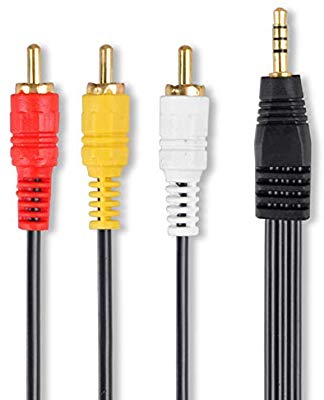
https://www.amazon.com/dp/B07GBRB7C4/ref=cm_sw_r_cp_awdb_t1_opI8Bb68R54D0
Repeat, does NOT work with Andor1!
#15 — sean · 2021-03-28
Wonder if anyone has experience with/thoughts on Polar Noise shielded patch cables?
I’m thinking of maybe picking some up.
#16 — rempesm · 2021-03-28
I swapped to using just these on my video synth and they’re great. They have a nice feel and have eliminated any cable related noise I was having.
#17 — prakodr · 2021-03-28
My local shop has really good prices on 3.5mm cables. They seem to be working fine so far.


https://www.ctrl-mod.com/collections/cables/3-5mm-Patch-CableSelection of Cables, Adapters & Accessories used with Eurorack modules and other audio applications.
Link: Cables
#18 — jnoble · 2021-03-28
I like CTRL cables, especially for crowded patches.
I stick to Canare L-3CFW for BNC, it’s beautiful.
#19 — jwsmithwick1 · 2021-03-28
I’ve had good experiences with the CTRL crono cables and the multi color cables. The plugs are designed to take up as little space as possible while still being rugged. I really like their 1/4” cables (and the 3.5mm to 1/4” adapters) for the same reason.
#20 — sean · 2021-03-30
Okay, another (similar!) question:
How about Tendrils (or other right-angled patch cables)? Thoughts?
#21 — vhsdestroyer · 2021-03-30
It gets a little tight using right angle cables on some modules. But definitely looks pretty neat.
#22 — Rik_bS · 2021-03-31
I’m a big fan of Tendrils, for more “committed” patching - they’re super flexible and tuck out of the way, perfect for routing that you don’t expect to change very often.
Here’s an example with an audio rack - EGs to VCAs to final mixer… and I’ll do similar with my video rack soon enough - ie RGB matrix to output module
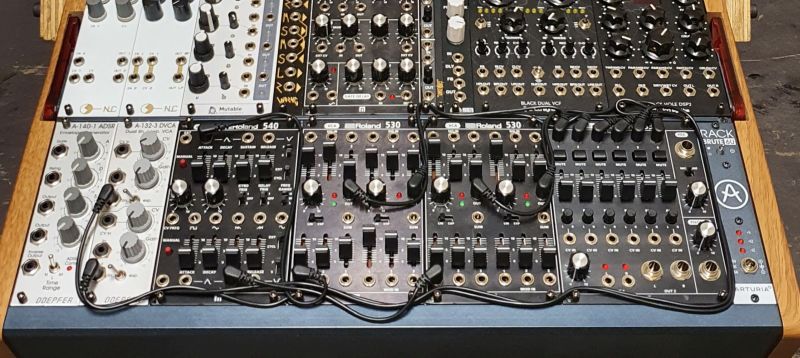
Now that there are more colours available, and the video rack is soon to be in need of them, I’ll definitely order more Tendrils!
Another favourite patch cable is from Synth Cable Supply Co - good feel with super thin and flexible cable, and low profile plug. Being local they’re relatively cheap, and hardly any packaging is a bonus too.
#23 — Dr_Rek · 2021-04-02
LZX RCA cables are great, haven’t found a better one yet.

#24 — Dr_Rek · 2021-04-02
They look like there is no breaks in the RCA ring. My experience with that type has been hit and miss, some female rca won’t fit them, like my rca to BNC adapters for my V4ex. Do they have breaks in the ring? I love the colors.
#25 — Dr_Rek · 2021-04-02
I’ve found this type to be a bit stiff for patching, but great for permanent / one time connections. How about you?

#26 — 337is · 2021-04-02
The black market RCA cables are definitely stiffer than the Amazon ones in my experience.
#27 — Dr_Rek · 2021-04-02
Ah yea, just to be clear, this in in reference to the ring, it can be tight, but fits most things. Not great for repeated patching with the tightness I experienced.
#28 — mfrosbot · 2021-08-02
Hi all,
I’m trying to work out how I can connect my dslr camera to my lzx system in the absence of a visual cortex, chromagnon, or TBC2 and am wondering if anyone can speak to the effectiveness of mono rca to 3.5mm aux (ts) cables in this context.
My plan was to use an adapter to convert my camera’s hdmi output to composite video, and then another adapter to convert from composite to component RGB. However the composite to rgb adapter outputs via three RCA jacks. I am curious if it would be possible to use one of these cables or similar to feed RGB signals into my lzx system or if there would be other voltage or syncing issues to consider.
Thanks!
#29 — joem · 2021-08-02
I know you’re talking about input, but what are you using as an output module from your LZX system? Most video output modules (aka encoders) need sync as an input somehow in order to generate the valid video signal output. Additionally, some non-encoder LZX modules need to be sync’d. This is one issue with your plan, though it might not be insurmountable, since the RGB format of the converter you mentioned is RGsB so it has sync mixed into the green channel. Depending on your LZX system, you may be able to mult the green channel and feed it into the sync input of your output encoder. Though it might not work too well since you’ll have signal mixed in with your sync. That’s another issue.
The last issue that pops to mind is the voltage levels. Composite and component video both have a video signal peak of about 0.7V, whereas LZX expects video peaks of 1.0V, so your image will be a bit dim. Additionally, I know composite video is usually AC-coupled so I wouldn’t be surprised if component video is too (since in a lot of ways they’re very similar), so you’d want to DC-restore your signal. (If you’re familiar with modular audio synthesis, this is kind of like converting a bipolar LFO to a unipolar LFO, sort of.) Without DC restoration, your signal will be even dimmer that the 0.3V difference noted previously.
#30 — joem · 2021-08-02
So, now that I got all that issue explanation out of the way, there may yet be hope, maybe…
You mentioned that you have an LZX system… What’s the sync source for your system? And what’s your output encoder? If you’re working with a Cadet system (or a mixed system with Cadet 1 as your sync generator), then you’d just need this: Syntonie VU003
That handles the YPbPr conversion and sync stripping, and you’d pass the green channel through your Cadet 1 before going into this, in order to sync your system (and output encoder).
(Alternatively, you could use three Cadet 3’s, but those are likely hard to find.)
If you’re working with a LZX Visionary system, I think that Syntonie module should work for that too.
#31 — mfrosbot · 2021-08-02
Wow thanks for the thorough reply!
I’m currently using a Memory Palace as the master sync generator and using it to clock a Fortress (and when it arrives in a few days a Diver as well), which then feeds back into the MP’s rgb inputs and the MP composite output is then going to my projector.
Sounds like that syntonie module is pretty close to what I’m looking for, would that also take care of the .7V voltage issue if i were to add a Cadet as the master sync source instead of using the Memory Palace as the sync source? This sounds preferable to multiplying the green sync from the adapter and feeding that into the Memory Palace’s sync in, if I’m reading your explanation right.
#32 — joem · 2021-08-02
Yes, I believe the Syntonie VU003 does DC restore the signal.
I don’t think you can sync a Memory Palace from a Cadet 1. Cadet 1 only produces 14-pin sync, while I believe Memory Palace only takes RCA sync. If you added a Cadet 2, that would produce RCA sync from the 14-pin sync (as long as you don’t plug anything into the inputs of the Cadet 2).
Unfortunately though there’s a problem with using the Cadets… They’re no longer in production, and they’re DIY. You may be able to find places that still have some for sale, but if you can’t solder them that won’t help. (They are fairly easy through-hole builds, though, so you don’t need to be a master, though there are a couple SMD parts on them that are a bit harder.) Or you may be able to find someone selling them already built, but there’s no guarantee you can find that.
So it might be best to try syncing the MP via the green channel. Before getting the VU003, you can test out syncing the MP via a sync+video signal easy enough. Just set it to be externally sync’d and plug any composite signal (or component green channel) playing some video into the sync input and see if the MP outputs its normal output without glitching. (If it does glitch, you’d want a “sync extractor” or “sync separator” to get the sync without the video, and there are a number of small DIY circuits that could be made to do just that.)
#33 — joem · 2021-08-02
Sorry it’s not more straightforward. We’re at an annoying time right now in between major LZX series, so there aren’t a lot of options for certain functions.
#34 — mfrosbot · 2021-08-07
Thanks! You’re right about this being a weird annoying in-between time, part of me just wants to wait until chromagnon and tbc2 ship but the other part of me feels like there should be a way to do it in the meantime, so I will try out the method you described.
Just to be extra clear though, since you mentioned that any composite signal can be used as a sync source for the MP: do you think I would be able to use a Syntonie VU001 to multiply my composite signal and then send one of those composites into the MP sync in, with a second composite signal going from the VU001 to my composite-to-component adapter, and then into a VU003 from there to convert to RGB?
Thanks again for the info!!
#35 — joem · 2021-08-07
Maybe? Just to be clear, I don’t have a MP, so I’ve never tried syncing one with a non-blank composite signal. Hopefully others can chime in about whether that works, or if it needs a clean blank signal to sync with. (Or since it sounds like you might have one already, you can try it out and see if it works. It shouldn’t damage it – the worst I can imagine happening is it just doesn’t sync right.)
As to your signal chain: maybe? The VU001 should do what you expect, as should the VU003, but I can’t say whether or not your composite-to-component adapter will keep the output in sync with the input.
#36 — joem · 2021-08-07
Oh! I know what should work better (again, assuming the MP can take a non-blank composite signal as sync):
Pretty much what you described, but move the VU001 to be after the composite-to-component adapter, and run the Y output from the c-to-c adapter through the VU001 then to the MP and the VU003’s Y input. The Y channel carries the sync, so that way, you’ll end up syncing the MP with the same signal you’re feeding into the VU003.
#37 — joem · 2021-08-07
(Sorry if that hid the last few posts for everyone – I didn’t realize what would happen. I flagged the discussion about getting video into the MP as off-topic in hopes they’d be moved to a separate thread, since it’s not really about video cables or patch cables.)
#38 — Rik_bS · 2021-08-07
Good move, worthy of its own discussion and keeps this thread on topic
#39 — dryodryo · 2023-01-12
Does anyone have information on which brands of 3.5 mm patch cables have the best fidelity for video? The least high frequency signal loss? Especially with HDTV formats, it makes a huge difference. I’m seeing noticeably softer video using TipTop Audio StackCables, compared to LZX RGB mini-snakes.
Shielding is nice, but I’m less concerned about noise than about signal loss. In a perfect world, someone would manufacture 3.5 mm cables optimized for video. Robust, high fidelity, well shielded.
#40 — jwsmithwick1 · 2023-01-12


https://www.ctrl-mod.com/collections/cables/3-5mm-patch-cableSelection of Cables, Adapters & Accessories used with Eurorack modules and other audio applications.
Link: Cables
I really like the Control Cables
It’s been mentioned that extra shielding causes capacitance, which degrades high frequency video signals.
#41 — syntonie · 2023-01-12
At first, I didn’t really noticed a difference between cables when using a linear power supply/SD system based around Cadets. Later, I switched to a lighter case powered by switching supplies, and the cheap no-name cables I was using were picking a lot of noise from the PSU, so I went for Polar Noise Shielded cables, which helped greatly with the noise.
Then I started building a system around HD modules, and that’s where cables shielding/length started making a difference. Both parameters effect the capacitance of the cable, which basically creates a filter between the two modules connected, hence why it helps with high frequency noise coming from a switching PSU.
Here are some tests I already posted on the Discord a while ago, with a black and white checkerboard in 720p60 as a source, with direct connection from VU003B to VU007B.
Same cable length, different shielding:

Same shielding, different cable length, Polar Noise Shielded iirc:

I’ve also tested with alligator clips (basically cables with no shielding), it does improve the bandwidth but picks up a lot of noise (from Capsule PSU iirc). Second capture is with RG179 cable and Rean jacks, RG179 is specified at 64pF/m, jack sockets also adds a bit of capacitance, so didn’t really noticed a difference with RGB minisnakes. Last one is Tendrils, which are up to par with Polar Noise Shielded from what I’ve tried:
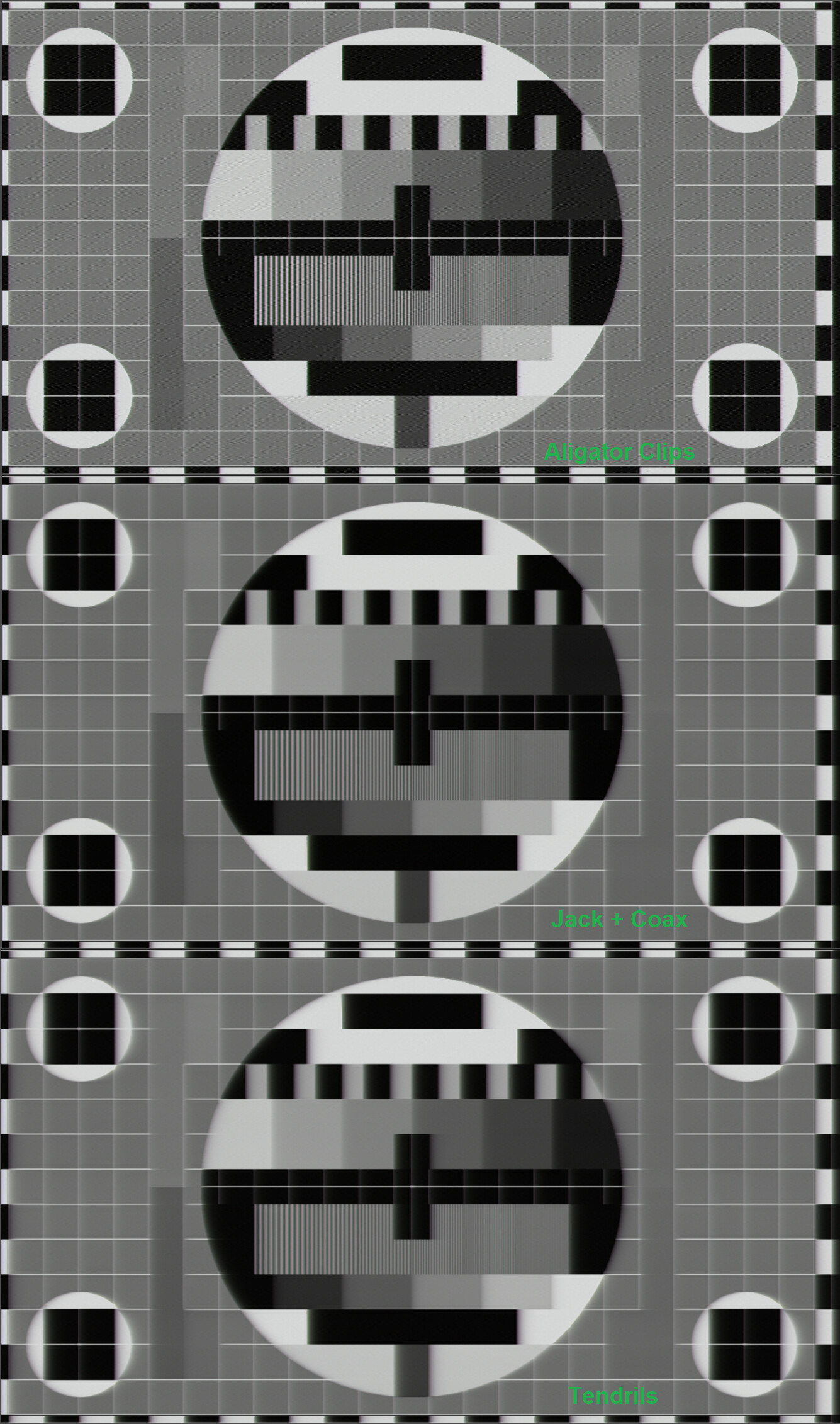
Haven’t tried other cable types, though seems like RGB Minisnake performs the best, then keeping connection between modules short does also help, but it gets tricky with dense patches and/or passive splitting. Also, all those captures are 720p60 which is the format that requires the most bandwidth, so going for a lower resolution/framerate could also help.
Seems like it will always be a tradeoff between bandwidth vs noise immunity, though I only tested with VU003B/VU007B with a Capsule power supply, I guess Gen3 modules might be less prone to noise since they all have their own integrated power supply.
#42 — creatorlars · 2023-01-12
syntonie wrote:
I guess Gen3 modules might be less prone to noise since they all have their own integrated power supply.
They should be – part of it is that the scale of any noise is much lower with +/-5V power rails than +/-12V rails. With Capsule power, we measured 1-2mV under full load. With the Gen3 integrated power, it is less than 400uV. Anything under 3-4mV is effectively ignored, once the video is digitized at 24-bit RGB.
#43 — dryodryo · 2023-01-12
Thanks Bastien, that is super helpful.
So far it looks like the best way to go is the RGB mini-snakes. When I have time, I will do some tests with the other cables I have here, TipTop, Hosa, and Ad Infinitum. Will report back with findings.
#44 — joem · 2023-01-13
Sounds like Gen 4 modules are going to need twisted pair differential signals/cables!
#45 — rempesm · 2023-01-13
If you think video modules are expensive now, just wait for how much they are with double or more the amount of op amps required for differential signals.

#46 — creatorlars · 2023-01-13
joem wrote:
Sounds like Gen > > 4> > modules are going to need twisted pair differential signals/cables!
I think the real answer, for that concern, is just that modules with 75R terminated video IO (on RCA or BNC connectors) is not excluded by the 1V patchable spec at all, they are part of it. So there’s nothing preventing someone from designing a “mastering series” module with BNC I/O for the sensitive video path, for example, and still including 1V CV inputs for modulation. We just haven’t made any modules like that yet.
Differential IOs can still be a thing, too – just split across two jacks (like the IQ +/- outs/ins on Swatch.)
#47 — dryodryo · 2023-01-14
creatorlars wrote:
there’s nothing preventing someone from designing a “mastering series” module with BNC I/O
Please do not make me go back to the Busted kNuckle Connectors. Frankly the Eurorack standard is too small and flimsy for that. Even just using the RCA jacks on decoders / encoders, I live in fear that by simply making the connection I am going to crack the module front panel, or worse. There is a reason the Sandin IP is built of all stainless steel front panels.
Also not really into the idea of differential signals carried by two 3.5mm cables, except in special cases. Eurorack is very compact. That’s great. Not everyone has a huge interior space for a monster system. Doubling the number of connections would increase patch complexity and HP width.
All I really want is a 3.5mm cable that can have lengths up to 1m without high frequency signal loss and without RF interference. In the absence of this, there’s actually a limit to how large a system can physically grow without introducing high frequency signal loss. At a certain point one would need to devote HP space to some kind of custom buss modules to send signals over longer distances via BNCs or whatever. Or just have tons of buffered mults everywhere.
By the way, I took the advice of @creatorlars and rebuilt my entire system to minimize cable lengths. Everything that needs video sync in one rack. All the low frequency signal sources in a separate rack. That’s not a solution to the problem of 3.5mm cables being crappy, but it’s a workaround for my mid-sized system, which will ultimately be 672 HP non-inclusive of Chromagnon.
#49 — analogbrainsurgeon · 2023-01-15
I think there might be some sync issues in the first two.
#50 — joem · 2023-01-15
For the record, I was just kidding about differential signals/cables.
#51 — dryodryo · 2023-01-16
I don’t think it’s totally crazy. Obviously it’s made it possible to send analog video down incredibly long cable runs, e.g. security cameras. Just difficult and expensive to implement in a modular synth.
#52 — creatorlars · 2023-01-17
joem wrote:
For the record, I was just kidding about differential signals/cables.
I understand! I’m quite happy with the performance of the Gen3 modules and 3.5mm patching in the noise/power/transmission department. It’s a practical and balanced approach to offering analog video art tools at the price point we’re targeting. I’m just saying that if we ever needed to accelerate the performance in that area, for example, for a very high precision use case (like a broadcast mastering tool), that nothing prevents us in the standard from having RCA/BNC IO directly on module.
#53 — Dr_Rek · 2023-02-17
Reviving this after I discovered noise when I plugged “black market” brand 3.5mm patch cables into the inputs on DSG3 without the other end patched elsewhere yet. It’s making a lot of uneven noise, and none of my other brands of 3.5mm patch cable brands show this behavior. Once the cable is patched to something else, it’s hard to determine if it’s more noisy than other brands, but this unpatched behavior is suspicious. Makes me wonder if these cables are related to the issues I’ve been having with noise in Mapper patches, as even separating Mapper onto it’s own rig with it’s own power I still got noisy patches.

Anyone got recommends for 3.5mm slim patch cable brands? Looking into Control as mentioned above, but taking another survey with this forum bump
#55 — creatorlars · 2023-02-17
Dr_Rek wrote:
but this unpatched behavior is suspicious.
That’s weird!
Did you try a few different blackmarket cables? Try both plugs?
All tests use cables of similar length? Just trying to rule out anything that may be effecting the measurement.
Makes me think the ground ring on the plug has a connectivity issue or is worn out, but if you’re seeing the same thing on a few different cables then that’s weird.
#56 — Dr_Rek · 2023-02-17
It was all 20 of my black market cables, 4 different lengths

They all made different but similar uneven noise patterns, I’ll take a capture soon. I think they are just not shielded well, the pattern changes and intensifies if I touch the cable anywhere on the length. Other brands none of this silliness.
#58 — dryodryo · 2023-03-06
Any chance of seeing the 15cm / 6" RGB mini-snakes again? Or some substitute? I missed the boat on this. Never knew they existed until I saw them in Nick’s demos.
#59 — creatorlars · 2023-03-06
I like the 6" size too. We only had them for a while – we’ll definitely keep it in mind when reorder time comes.
#60 — nerdware · 2023-03-06
I use mine in every patch. I could use a few more!
Thanks.