All About Diver
Category: Legacy Docs · Tags: diver, eurorack, orion · Posts: 23
#1 — Z0NK0UT · 2019-08-25
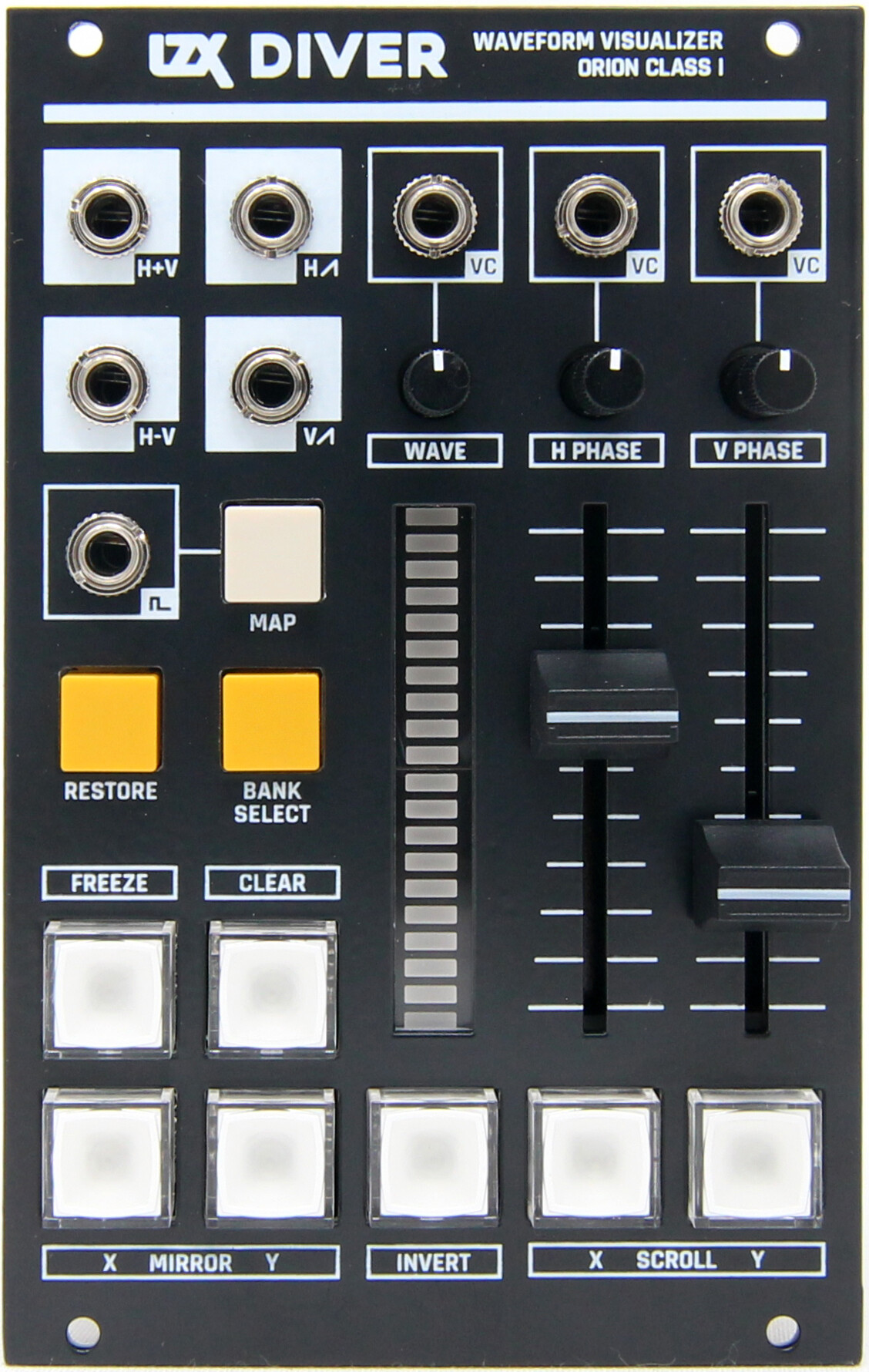
A new concept in pattern generation for video synthesizers. Diver is a single axis waveform sampler, ramps generator and digital effects buffer which translates audio signals to the 2D space of the analog video frame. Add scrolling motion to your patches and transform any audio source into a powerful shape generator.
Specifications
- Width, 16HP
- Mounting Depth, 32mm
- Power +12V @ 80mA
- Power -12V @ 10mA
Videos
https://www.youtube.com/watch?v=INzBFDMsHqU
Basic Usage
- Patch Diver’s H and V ramp outputs to your video output. Play with the phase controls. Push all the illuminated buttons to see what they do to the default ramp shape. Once you’re comfortable, move on.
- Patch an audio source into the WAVE input jack, and turn its level control up. You should see audio superimposed over your ramp shape. Check out what happens when you hit the freeze button now. Frozen! Now keep hitting that freeze button a lot to see what a strobed capture looks like. Neat!
- Patch your audio source into H Phase input instead. See how that looks different. Now you’re ready to move on.
Selecting A Bank
- Press the Bank Select button. The central LED window will show your currently selected bank. Bank #1 is at the bottom. Bank #20 is at the top.
- If you don’t press the bank select again within 3 seconds, the LED window will switch back to showing you a visualization of the current waveform.
- If you do press bank select again, you will advance to the next bank.
- There are 8 selectable banks. Banks #1 thru #6 have preset ramp shapes. From first to last, they are: Linear, Expo, Log, 4bit, 3bit & 2bit. Bank #7 has no ramp shape, it just captures the audio signal present on the Wave input. Bank #8 has no ramp shape either, but is meant for capturing sources that are synchronized to Vertical Sync (like video oscillators.)
Mapping The Trigger Input
- The trigger input can be mapped to any of 7 different destinations: Freeze, Clear, Mirror X, Mirror Y, Invert, Scroll X and Scroll Y.
- To map the trigger input to a destination, hold down the MAP button. The LEDs inside the illuminated buttons will switch to show you which are selected, and which are not.
- Continuing to hold the map button, push the buttons for the parameters you wish to control, to turn the mapping on or off.
- Release the MAP button.
Firmware Versions
- There have been no firmware updates since the first production run in August 2019.
Firmware Update Instructions
- Currently firmware upgrade is only supported for PC.
- Install the DfuSeDemo application available for free download at https://www.st.com/en/development-tools/stsw-stm32080.html. Click the Get Software button near the bottom of the page. You may need to create an account.
- Install the DfuSeDemo application and USB drivers.
- Next, download and save the most recent DFU file available at https://github.com/lzxindustries/firmware/tree/master/diver.
- Open the DfuSeDemo application. In the Upgrade or Verify Action section, click the Choose… button and then select the DFU file downloaded in the previous step.
- Remove the module from your EuroRack and disconnect EuroRack power.
- Connect a USB Mini-B to USB A cable to the rear of your module. Then connect the cable to an unused USB port on your PC.
- The DfuSeDemo app should recognize your module as STM32 Device in DFU Mode.
- Click the Upgrade button. You should receive an Upgrade Successful message after a few seconds.
- You may now disconnect your module from USB and reinstall it in your EuroRack case.
Known Issues
- First revision firmware for Diver can produce sync anomalies (flickering and misalignment) with some sync sources.
- 90 modules produced in late 2020 and early 2021 have mislabeled sync inputs on the rear. The function of the two RCA jacks are reversed.
Other Resources
#2 — Z0NK0UT · 2020-05-09
Lars, via the FB group:
“I suppose it’s important to think back to early LZX days to explain Diver. One of the areas we were trying to expand the system was in opening up the 2D space of the patch. Areas analog VCOs were limited was the lack of being able to dial in smooth scrolls in both horizontal and vertical dimensions. To this end I prototyped an XMEGA based sync pulse modifier that allowed you to scroll the VSYNC and HSYNC up or down at varying speeds. You then patched the altered H and V pulses to two oscillators and could make the whole pattern scroll in any direction. So this is what Diver is at it’s core. The second design concept we had was an “audio 90 degree rotator” a very simple module that would sample audio VCOs and play them back at video frequencies. This would turn any audio source from your other synthesizer into a capable high frequency Video VCO. So Diver is a marriage of these two modules, and also an inheritor of the performance focused design language of Orion Series. And it’s also a ramp generator!”
Regarding sync anomalies:
“Diver’s very sensitive to the sync setup. I’m sorry for that. There’s a momentary hiccup that can occur every couple minutes even when it’s working nicely. The line is an artifact of how Diver works – by taking 1 audio rate sample per HSYNC and then putting that into a fixed playback buffer, there’s a crossover point where the texture wraps. If this were an analogue waveform you’d just see it as the edge of a sawtooth or square wave, but here I probably need to just interpolate across a few values near the crossover point. Diver isn’t an image processor, it’s a hyper-speed audio player, so it’s not quite the same as a frame buffer effect. Diver really shines for me when you are strobing it with an external clock into the gate input for freeze frame triggering.”
#3 — warpigs666 · 2020-05-12
Can you confirm the power specs above are right, and wrong on modulargrid? If so I can update it.
#4 — Z0NK0UT · 2020-05-12
Z0NK0UT wrote:
-
Power +12V @ 80mA>>- > Power -12V @ 10mA>>>>
These are the correct specs. I am not sure where the ModularGrid info came from.
#11 — Z0NK0UT · 2020-05-19
#12 — Z0NK0UT · 2021-02-10
#13 — Robbertunist · 2021-03-05
Z0NK0UT wrote:
90 modules produced in late 2020 and early 2021 have mislabeled sync inputs on the rear. The function of the two RCA jacks are reversed.
I hate to state the obvious but a photo would really help. Also the production numbers of the 90, e.g. 234 to 323. My recently bought one doesn’t have a serial number

The Sync In (J30) is on the left when looking at the PCB from the back of the module, Sync Thru (J31) is on the right.
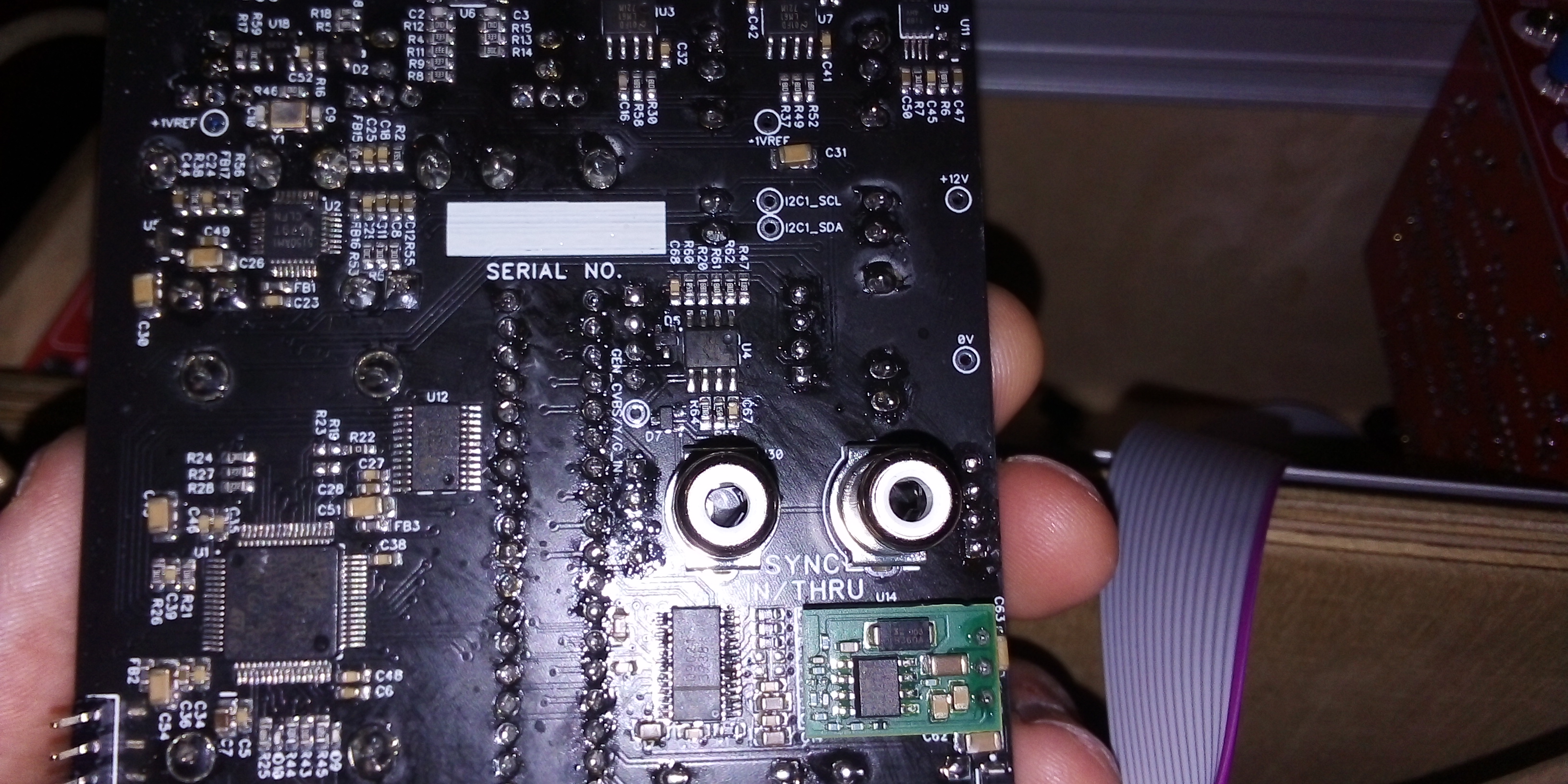
Update: I used the Sync Thru instead of the Sync In and everything seemed to work. I made some cool imagery. I’ll happily delete this post soon so as to keep this page about Diver & not is temporary issues.
#14 — eraxeg · 2021-03-05
I can add that my unit which has the reversed sync inputs also lacks a serial number.
#15 — a_digital_index · 2021-03-14
Request: in future firmware will it be possible for Diver to save last used settings when powering back up? I generally don’t remember what bank I’m using on a patch.
#16 — efp3 · 2021-03-17
That would be nice! I usually just count and remember how many steps.
#17 — wiatrob · 2021-03-17
This is on the feature request list I believe.
#18 — a_digital_index · 2021-03-17
Good to hear. Sorry for the redundancy. Hard to track requests across all the channels.
#19 — wiatrob · 2021-03-17
Happy to have a little redundancy to reinforce the need for Diver updates - it’s one of my most used modules.
#20 — a_digital_index · 2021-03-17
I have to admit I didn’t think I would use Diver much but it is pretty much in every patch now. Such a great partner for the Memory Palace.
#21 — efp3 · 2021-03-18
I love Diver! It reacts really well to audio!
#22 — Kent · 2022-03-13
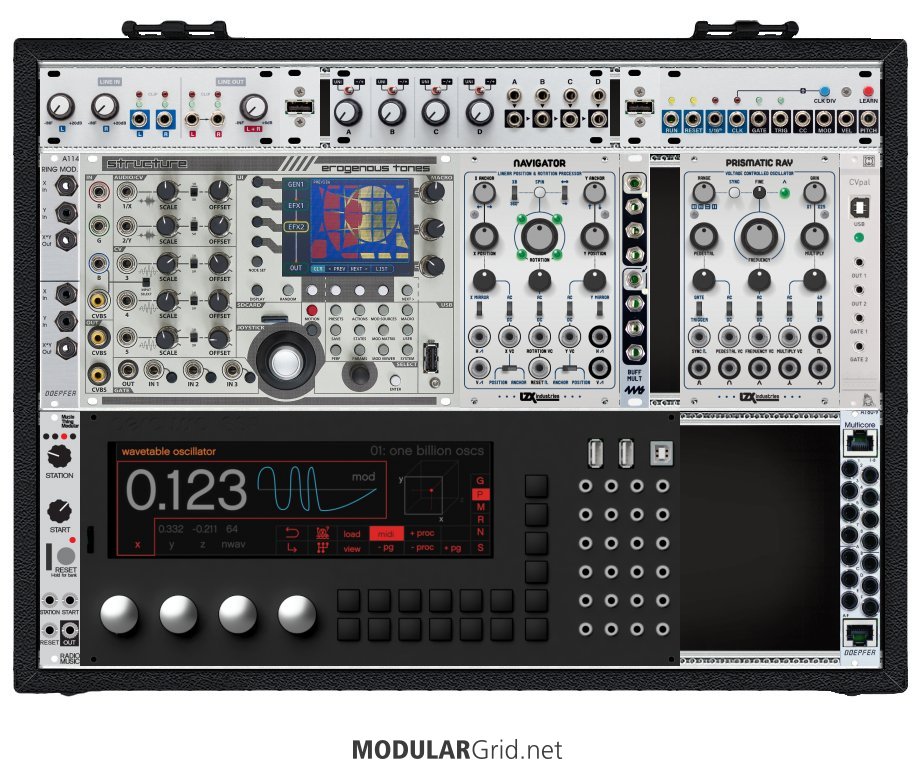
I’m utterly confused by Diver because I’m a tier 2 newb at this stuff. Above is my rig.
I use Structure as the backbone of my system and I don’t know if generating video rate waves is something of value for me. I know that Diver can take an audio waveform and then use it as a modulation source, but I still don’t know WTF is going on.
I’ve tried injected Prismatic Ray’s H and V ramps into Structure, and I suspect that it is looking for audio rate, at best, on the first two control inputs. Those first inputs are designed for audio input.
Can anyone provide a clear explanation as to what Diver does (I’ve watched every video) and if it could bring anything to a Structure based system?
I suspect that Structure is oriented toward shaders and such and not true video rate shape creation. In fact, I’m pretty certain of this but my suspicions are that Diver would be wasted on a system like this.
Thanks.
#23 — Robbertunist · 2022-03-13
Do you think you can chime in here @Marizu? I definitely know you have a Structure and I also think you’ve got a Diver.
@Kent, I guess the first problem is not having a Visual Cortex & that Structure is definitely not 100% LZX standard compatible because like you said, Structure deals with Shaders and its output format is different.
There definitely is a Structure page on here & the design team would surely help illuminate things if you tagged them. There’s also many Structure users on here & I’d actually suggest creating a unique post for this issue because there’s definitely a few Structure users still looking for a Cortex but can’t fully implement other LZX modules as well as they would like to.
DIVER in its most simple form is a H&V Ramps generator but the outputs are 1V & Structure is probably looking for up to 10V audio rate & CV signals on some or all of its jack inputs. I’m sure that a scrolling bar going up or down is the equivalent of a very slow audio wave/LFO signal so that should do something on structure but you’ve got to amplify it.
I’ve definitely seen people feed video images into via a camera or laptop, surely this is achieved via the component (Yellow RCA) input jack.
#24 — Marizu · 2022-03-13
Hi @Kent , I have Structure and Diver. In my opinion, Structure doesn’t currently play particularly well with existing LZX based workflow because it only has composite video out. It doesn’t have 1v R,G and B outs. Structure provides great bang for the bucks but then it is problematic to expand from there.
Several people that start with Structure keep running into this. I’ve responded to a few of these type of posts on ModWiggler. https://www.modwiggler.com/forum/viewtopic.php?p=3582031&hilit=structure#p3582031 https://www.modwiggler.com/forum/viewtopic.php?p=3603034&hilit=structure#p3603034
You can input video rate signals into Structure through the R, G and B inputs on the left. You have to have the Input Select switch set correctly. The incoming images come in to a VID node. In order for this to work, you would need to have Structure synced to the incoming 1v signals using the RCA on the back. I don’t see anything in this rig that will generate those sync signals. Don’t buy any more LZX until you have sorted this out. This isn’t really a Diver question. It’s a Structure question and should really be asked on a Structure post. If you post anything else, PM me and I’ll respond to it.
That said, Structure can be a pretty solid standalone video synthesiser. It’s well supported, good for quick/big changes and always being updated. It pairs well with Sensory Translator for a small standalone rig.
#25 — Kent · 2022-03-23
Thanks for the replies, folks. Much appreciated.
I’ve been under the weather with a 2nd round of Ye Olde C-19 and I keep forgetting to add a reply of gratitude.
One note worthy of mention: the Structure has individual switches for optimizing the CV inputs to LZX standard or Euro-pseudo-standard.
#26 — Robbertunist · 2022-07-04
Was there ever an instruction manual/user guide created for Diver @z0nk0ut? Such a pdf surely exists but may not have been finished. It’d be a good addition to this product page even if it’s not perfect. Someone here may have the time to finish it, I’d happily give it a try.
#27 — Z0NK0UT · 2022-07-04
Thank you for the offer. The first post in this thread is the manual/user guide for Diver. We plan on updating the post once the new firmware is ready. Are there functions or features that you feel are not sufficiently explained?
The advantage to using this forum post in lieu of a printed (or PDF) manual is that it’s a living document that can change along with Diver and grow as we (as a community of Diver users) become more acquainted with the module.
#28 — Robbertunist · 2022-07-04
Someone on the LZX Discord server said that they previously had a Diver but had forgotten what the Freeze & Clear functions. A couple of us chimed in but I figured a link to the manual & then this page would help.
Those are really nice points about a “living document”

Thankfully I’m a Diver user without any glitch issues but I’m really looking forward to see what some new creative uses can come from some future firmware updates 