Video DIY Modules 2022
Category: Unknown · Tags: cadet, castle, diy · Posts: 31
#1 — phosphenes · 2022-01-26
Hi All
With lots of really exciting developments around Gen 3 I thought I’d start a thread about the current state of DIY modules! 2021 saw some really cool stuff released, shout-outs to Syntonie, Visible Signals, Fox, Reverse Landfill and more for expanding the video DIY cinematic universe.
As Gen 3 keeps pushing the quality and complexity possible in a video system its going to be interesting to see how DIY can ‘keep up’, as the disparity between what is possible with the newest Gen 3 and a cadet system is getting bigger all the time!
Would be great to hear if anyone has anything in development, new ideas or even if there’s any updates from LZX (although I really don’t want to be pushy as I know how busy things are and DIY is definitely quite a long way down the pile!).
#2 — Rik_bS · 2022-01-26
Other designers (predominantly DIY) really have more opportunities to “fill the gaps” rather than “keep up” with LZX - especially around utility and alternate/experimental functionality.
I’m halfway through building a row of Visible Signals modules and once they’re finished I plan to share details of them on here, it’s not new stuff as such but hasn’t seen much discussion on this forum.
Really keen to see what Syntonie has in the pipeline (his teaser instagram posts are up to about VU053 now?) and Reverse Landfill’s waveshaper and feedback filter have already seen sneak previews - these are the sort of things I have in mind when referring to “alternate” functionality… stuff that is between the fairly static lofi/circuit bent devices and an LZX-based system.
#3 — phosphenes · 2022-01-26
Definitely agree, ‘keep up’ might have been a poor choice of words!
My visible signals modules are fantastic, going to build up a 5th gain brain and Wrangler for my vector stuff soon and that will be my LC6 full. I think a set of castles will grace a second case.
Hopefully a few more options for oscillators and shape creation coming soon.
#4 — creatorlars · 2022-01-26
We definitely want to continue support for everything video synth DIY throughout Gen3 – now that we’re wrapping up the infrastructure and basic modules, it’s a good time to talk about it and get everyone’s ideas.
A couple things we need to make DIY friendly:
- SD/HD sync generator / video encoder / input amp / ramp generator circuits
- Low noise power solution that supports +12V barrel power entry
And there are a few questions to answer – In the Gen3 design standard, LZX has some specific constraints about signal paths (no passive attenuators, etc, being a very relevant one.) There’s also some mechanical constraints, like maximum mounting depth allowed. DIY doesn’t necessarily have to follow those same rules. The main concern with DIY is compatibility with the SD/HD sync modes, and 12V power distribution. So what approach to take? A minimal one, where we just make sure to provide a solution for it all to “work”? Or more of a master reference for matching all of our own circuit design/dimensional requirements?
I don’t know if this looks like a revision of the Cadet model, or something different. Most of the Cadet designs will adapt just fine to Gen3, once a power circuit is devised.
I hate to think of a DIY system that relies on purchasing an OEM subassembly, but that may be part of the solution for some of this. We could perhaps open source the hardware for the infrastructure PCBs specifically (power entry, power/sync entry, and power/sync generator.) It’s possible to DIY these PCBs – there are no BGA parts – but there are multiple PCN parts with ground pads underneath the IC, so at a minimum it requires hot air and an intermediate level of experience with SMT assembly.
It’s also possible we could engineer a more “DIY friendly solution” to sync and power, like for sync, using an off the shelf devboard on a DIY host PCB. Or make it an entirely new project, like a “video devboard/system core.”
I’m interested in anyone’s thoughts or ideas.
#5 — phosphenes · 2022-01-26
I think a revision of the Cadet series would be extremely welcome in the community. An LZX reference application sheet like the legendary AN57 would be incredible! Open source schematics are something I’ve learnt a huge amount from.
In terms of the power solution I don’t see an issue with an OEM subassembly, you put the development time in for this low noise power solution and I imagine its considerably more complex than basic building blocks like an op amp circuit. Could a single LZX power distro board be shared among several ‘Gen 3 Cadets’ but still using the normal Euro power connector to allow some choice for the user?
#6 — VanTa · 2022-01-26
Exactly, im also thinking that DIY doesn’t need to keep up. It can fill the gaps, or take different directions. Lzx is years ahead of what most of us can design. Gen3 felt for me like the first iPhone to someone that was trying to understand how a Nokia works.

For example ive a 1u 3channel mixer that can be built with just one lm6172. Obviously it doesn’t meet the gen3 standards, not even regular lzx quality standards. (Impedance, cross talk, etc) but I see value on it for more glitch patches or performance oriented scenarios, for example.
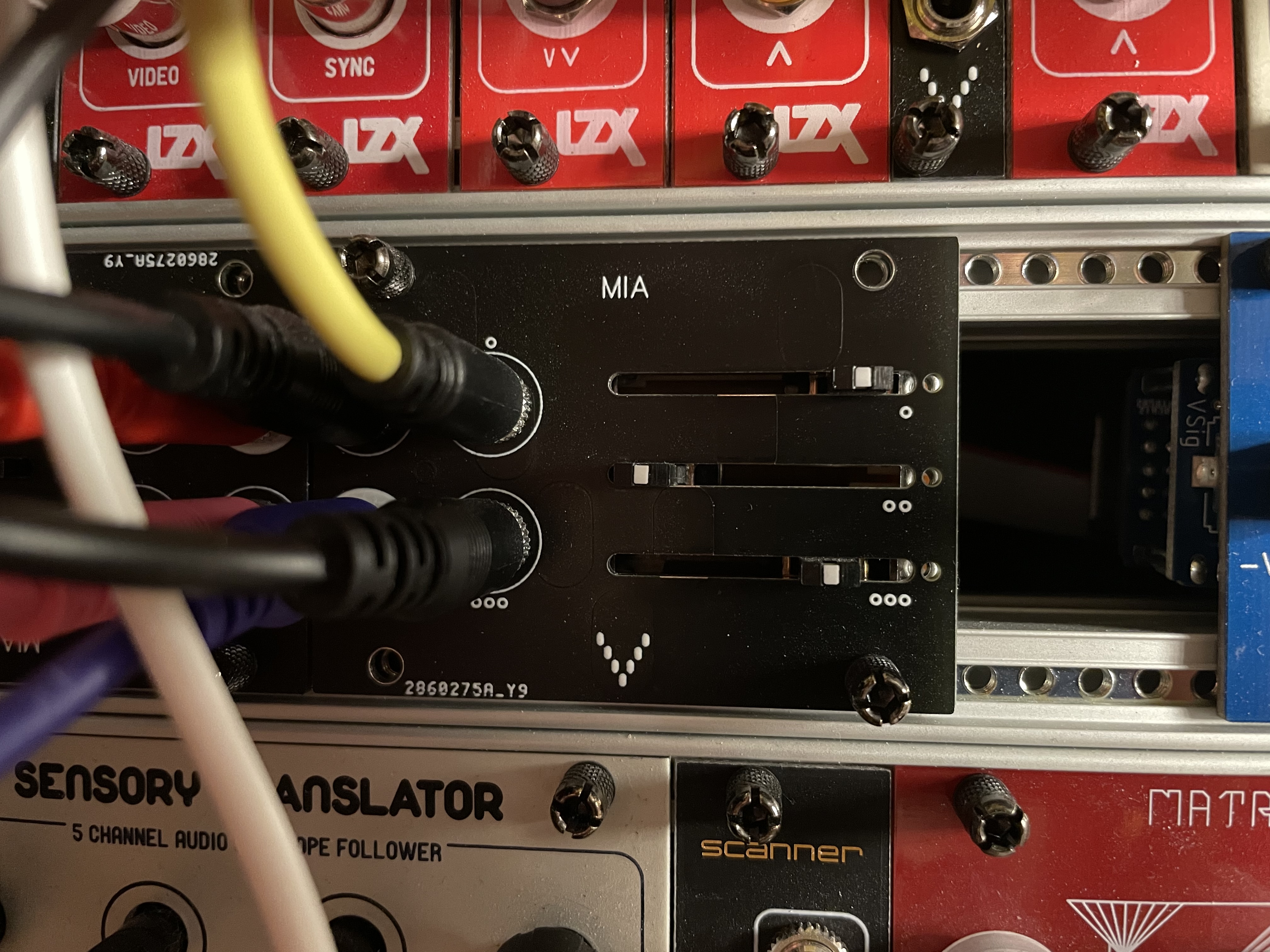
Another small thing I’m working on is a 3x passive
Attenuator that can also be used as an expansion for reverselandfill matrix mixer or my own matrix mixer. In this case your signal goes through a slide potentiometer (contrary to the signal paths that gen3 has, where the potentiometers are control signals for vcas) in level the signal degrades as the potentiometer eventually degrades.
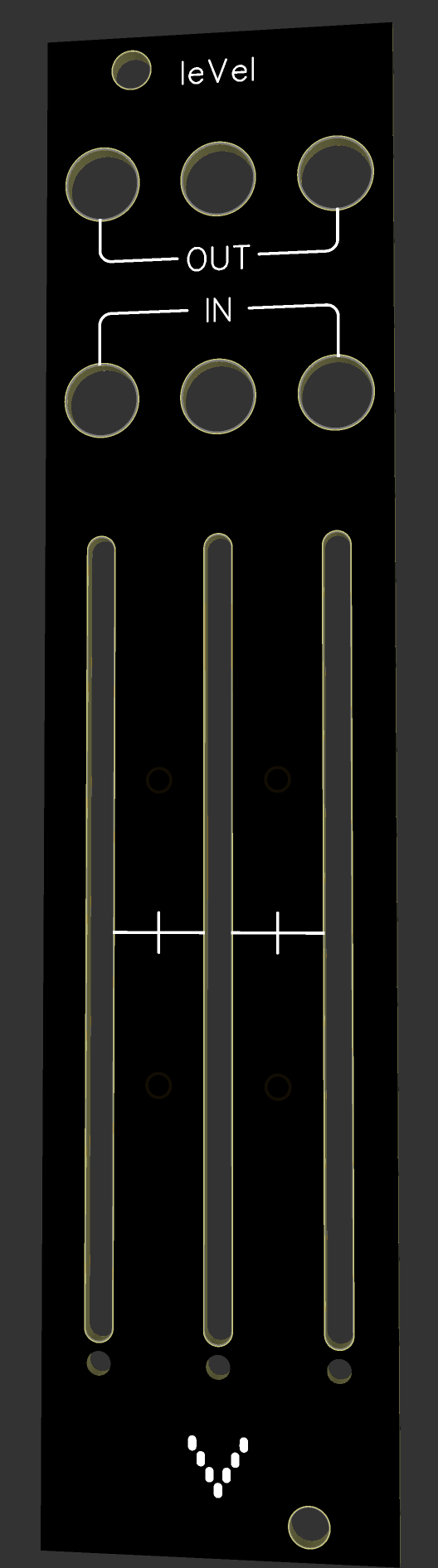
So filling the gaps and giving alternate approaches is something diy can offer still.
Regarding what LZX can offer to the diy community:
First: thank you, you’ve done a lot. without you guys I’ve never started remixing and creating circuits.
Second: hd/gen3 versions of cadets, what Lars mentioned in points 1 and 2. Of course, that will help a lot.
But what I’m more interested would be that oem clean power board to be attached to diy modules. If diy creators could offer the option of :
-get your kit from us and
-get your input power board from lzx
I feel that’s something everybody can benefit from, on our side no more designing power blocks for every single module and relying on a clean and well designed one from lzx.
And on lzx side, keep benefiting from an already made design.
#7 — creatorlars · 2022-01-26
phosphenes wrote:
Could a single LZX power distro board be shared among several ‘Gen 3 Cadets’ but still using the normal Euro power connector to allow some choice for the user?
If everyone were into this concept, I think it might work out best. All the LZX power entry board variants are fully independent +/-5V 1A power supplies with a single +12V input (from DC barrel or EuroRack input connector.) +/-5V at 1 Amp per rail is a decent bit of power, and if we’re hoping to keep sticking to smaller module sizes like 4HP, that could power several modules. Power could be distributed from the power board to small modules via 4-pin molex cables or something like that, and power entry per module would look like the existing cadets do (just ferrite beads and input capacitors.)
But it would be a pretty fixed configuration, meaning it would be hard to design a DIY module that worked that way and also supported a different build option.
On the other hand, +/-5V power opens up a lot of options for video bandwidth ICs, so we’d no longer be stuck with LM6172 as we have in the past! So that definitely helps offset the power budget some.
I’ll keep thinking and sharing notes as I do – y’all do the same!
#8 — creatorlars · 2022-01-26
I guess to clarify what I’m saying in the last post a bit more:
-
One way to handle power for DIY modules would be direct +/-5V power rail entry. The power could be provided by an LZX power/molex distro board or any other +/-5V power solution the DIYer provided. This may be the best solution if the hope is to continue releasing 4HP/6HP/8HP sized modules, or a more direct adaptation of Cadet for example.
-
Another way to handle it would be that we release some form factor templates for the existing power subassemblies exactly as used on LZX production modules, and make those available OEM. Then you could use them the same way we’re doing for the Gen3 assemblies, as a vertical stackup. The issue becomes that 8HP is the minimum module size, and for modules with sync, that is 12HP. So Cadet style 4HP modules would be difficult or not possible. Full EuroRack/12V cross compatibility is the big advantage here, and the ability to make DIY modules that fit all the other form factor rules.
So option one is perhaps the most open / freeform, since with direct +/-5V entry you could power that with linear power supplies or whatever you wanted to. Biggest disadvantage is introducing some new cable or connector type into the equation.
Option two is possibly the the path of least resistance, since we’ve already designed this solution. It is EuroRack and 12V cross compatible out of the gate. It definitely makes things easier for third parties selling modules or DIYers adding to or creating Gen3 compatible systems. Biggest disadvantages are no small modules and that the power entry infrastructure is a cost of entry. And it would be either very difficult to DIY, or only available OEM. Availability I don’t think would be an issue, because we’d be making all of these for production modules constantly already.
Some sort of overlapping standard of the two options may be possible, too, or options we haven’t thought of yet.
#9 — phosphenes · 2022-01-27
So just to clarify, a new generation of Cadets would do away with the +/-12V supply and instead use +/-5V across designs?
4HP has its benefits so it would be great to keep the option of having smaller modules, even 2HP utilities like buffers, attenuators and VCAs would be great.
I don’t think introducing a new cable would be a big problem, Molex ribbon cables are inexpensive and easy to make. I think using an LZX Power Distro board allows more choice. I’d be inclined to say an overlap of the two options might be best.
#10 — creatorlars · 2022-01-27
phosphenes wrote:
So just to clarify, a new generation of Cadets would do away with the +/-12V supply and instead use +/-5V across designs?
The issue is really that new LZX projects need to support direct +12V “noisy” power entry, potentially from a noisy Euro supply or a wall-wart. So whether internal to the module that is +/-5V or that is +/-12V, could be determined by the module. But +/-5V is, without much room for argument, the way to go, if we were to pick the most compatible option for video ICs in general.
Using +/-12V in the first place is derived from being compatible with EuroRack native +/-12V supplies, something that was OK in the early EuroRack days, when everyone’s rig used linear power supplies – but it’s become a nightmare for us and lots of you after the proliferation of switching supplies.
So the new LZX power entry attempts to solve the problem by supplying 12V as a bulk DC input (like broadcast gear, cameras, LED lighting) and then cleaning that up and generating the +/-5V precision low noise rails, is part of the function of that board.
So this leaves us in a weird spot with DIY. I’d really like to hear everyone’s thoughts on it. There may be solutions I haven’t thought of yet.
One option is to come up with single rail designs, and derive that directly from the “noisy” +12V using a thru-hole regulator and some filtering, and perhaps the EMI filter from the LZX part from the LZX power entry.
#11 — sean · 2022-01-28
I plan to stick with Euro power, except maybe for modules that have high power draw like TBC2 when it finally arrives. I already have multiple cases with reasonably clean power, so it is not an issue. And, importantly, I use many non-LZX modules (both video and non-video ones) that need that clean Euro power anyway. So switching completely over to your new scheme sounds like a nice dream and all but never, ever, ever going to happen.
So yeah, myself, I’d rather the new Cadets just stick with Euro power and not require the adtl cost and/or build complications of more robust per module power filtering. It seems perfectly reasonable to me that one would expect a DIY builder to figure out clean power externally.
But, if you switched to Syntonie-style 4hp stacked boards, I could see having multiple backend power boards, depending on which way one wants to go. Though I assume you probably don’t want to create a 3rd power entry though — let alone two versions of a 3rd one (and maybe not possible on such a small footprint?). I kind of go back and forth on whether I like those sorta mincy stacked board anyway; perpendicular boards are generally much easier to build.
I really like 4hp single-function modules and would be sad if those went away. (Esp. if the reason was some power scheme that I don’t really plan to use anyway.)
#12 — creatorlars · 2022-01-28
sean wrote:
So switching completely over to your new scheme sounds like a nice dream and all but never, ever, ever going to happen.
That’s not the expectation at all (which is why all the new LZX stuff is both +12V and EuroRack power entry.) The only complication is with how to reintroduce DIY modules and reference circuits for designing them.
LZX as an entity should try to keep any variations on expectations at a minimum – for example, including 14-pin sync on the original Cadets was a mistake when we released those at the same time with Visual Cortex (our transition to using RCA sync only on production modules.)
But, if you switched to Syntonie-style 4hp stacked boards, I could see having multiple backend power boards, depending on which way one wants to go.
That’s the direction we went. The Gen3 stackup is either 2x (control + power) or 3x (control + core + power) PCB stackups. The minimum size for our power entry board is 8HP though, and 12HP with any rear sync IO. It’s just the cost of doing this right.
I really like 4hp single-function modules and would be sad if those went away. (Esp. if the reason was some power scheme that I don’t really plan to use anyway.)
How do you feel about dual function modules? Dual Cadet in 8HP?
#13 — sean · 2022-01-28
creatorlars wrote:
How do you feel about dual function modules? Dual Cadet in 8HP?
If things were going to have to gang up, in many cases I’d probably prefer triple modules (depending on the function, I guess).
But it is also kind of nice to be able to build one, see how it is working for me, before deciding on multiples.
#14 — sean · 2022-01-28
Okay, looking back at the Cadet functions — rather than just thinking of it in my head — I’d say, if forced to go past 4hp, it’d break down like this, personally:
Scaler, Oscillator, Ramps, Video Input: dual would be fine (edit: or maybe a more option-packed Ramps, since it is already dual in 4hp)
Multiplier, Processor, Fader, Key Gen: would rather have 3x (edit: or gang up Multiplier & Processor; and Fader & Key Gen)
Encoder/Sync Gen: ganging these functions up would seem to make sense
Granted, take this with a grain of salt, because many/most of these are things I am not sure I would buy in the near future either way (nor did I in the past; I have almost all Castles but only a few Cadets; though this was partly based on availability and the deprecated sync schema, so…

).
#15 — rempesm · 2022-01-28
Quads of functions are where it’s at for YRGB manipulation so dual Cadet functions in 8HP sound awesome. I am rarely using just one of a function in my patches and there are some obvious pairs you could put together, like @sean suggested, if doubled up single functions don’t feel right.
I bet there might just be a few makers in the scene who could readily make use of OEM power/sync boards to save them reinventing the wheel.

Power has been such a headache for so many users that standardizing the solution to it is a smart move.
creatorlars wrote:
SD/HD sync generator / video encoder / input amp / ramp generator circuits
I really like the idea of an advanced video experimenter’s board that covers this.
#16 — creatorlars · 2022-01-28
I bet there might just be a few makers in the scene who could readily make use of OEM power/sync boards to save them reinventing the wheel.
Yeah, regardless of the state of Cadet or DIY reference designs, we need to make that happen.
rempesm wrote:
Quads of functions are where it’s at for YRGB manipulation so dual Cadet functions in 8HP sound awesome. I am rarely using just one of a function in my patches and there are some obvious pairs you could put together, like > @sean> suggested, if doubled up single functions don’t feel right.
Certainly! The point of the Cadets are to be reference designs. So we can also rethink what that means for 8HP and 12HP modules.
#17 — Jesse · 2022-01-28
OEM sync/power subassemblies seems like an awesome way to go. Y’all get huge bulk buying/mfg discounts - probably could get them to DIY’ers for a really competitive price compared to them having to both reinvent the wheel & source the rubber to make the tires. They can focus on the “fun” stuff
#18 — Rik_bS · 2022-01-28
Rows of of 4HP modules (with many multiples) is a real hassle for euro power cable routing, would much rather build/buy 8-12hp units that are either dual/quad of the same function or perhaps two related functions on one panel… especially if it enabled the use of LZX power sub-module.
As for other designers, they can be free to choose what option suits them.
#19 — Marizu · 2022-01-28
creatorlars wrote:
How do you feel about dual function modules? Dual Cadet in 8HP?
This makes logical sense but one advantage of the Cadets and Castles was that when you are starting a system and may not be completely invested in video, the single modules allowed you to add small but useful fucntional blocks for a relatively low outlay.
I know a few creators that have mainly Castle/Cadet rigs for this reason. It’s what I did.
#20 — Marizu · 2022-01-28
creatorlars wrote:
So the new LZX power entry attempts to solve the problem by supplying 12V as a bulk DC input (like broadcast gear, cameras, LED lighting) and then cleaning that up and generating the +/-5V precision low noise rails, is part of the function of that board.
Some of these PSU’s seem to have floating grounds. Is this likely to cause problems when patching between cases, or even when you have two power supplies in the same case?
Will we need to start using Buchla type ground straps?
#21 — phosphenes · 2022-01-28
Agreed. Cadet’s were my only route into hardware video synthesis when I started out so in terms of accessibility I think preserving 4HP, or at least the low cost, is really important. Dual / Triple modules are fine but I think keeping cost of admission down for a basic system will benefit the community.
#22 — reverselandfill · 2022-01-28
creatorlars wrote:
How do you feel about dual function modules? Dual Cadet in 8HP?
I’m all for dual (or triple) modules.
8 or 12HP is fine by me.
A video modular is also about performing, so a bit more space on the panel is a good thing.
Most of my modules are 8HP or bigger.
The new ones will have sandwiched pcbs, as I prefer modules with minimal depth and vertical parts
#23 — creatorlars · 2022-01-28
Marizu wrote:
Some of these PSU’s seem to have floating grounds. Is this likely to cause problems when patching between cases, or even when you have two power supplies in the same case?>>>> Will we need to start using Buchla type ground straps?
I don’t think so, we haven’t measured any need for that yet, and it could actually create issues rather than solve them. Input ground (from either EuroRack or DC 12V barrel) is completely isolated from the power supply/internal ground on the LZX power entry architecture, via a very nice Murata EMI choke/filter. The signal ground will get passed on the cable when you make the patch. The clean analogue rails internal to the module never get patched around the system to other modules; they are isolated to that one assembly.
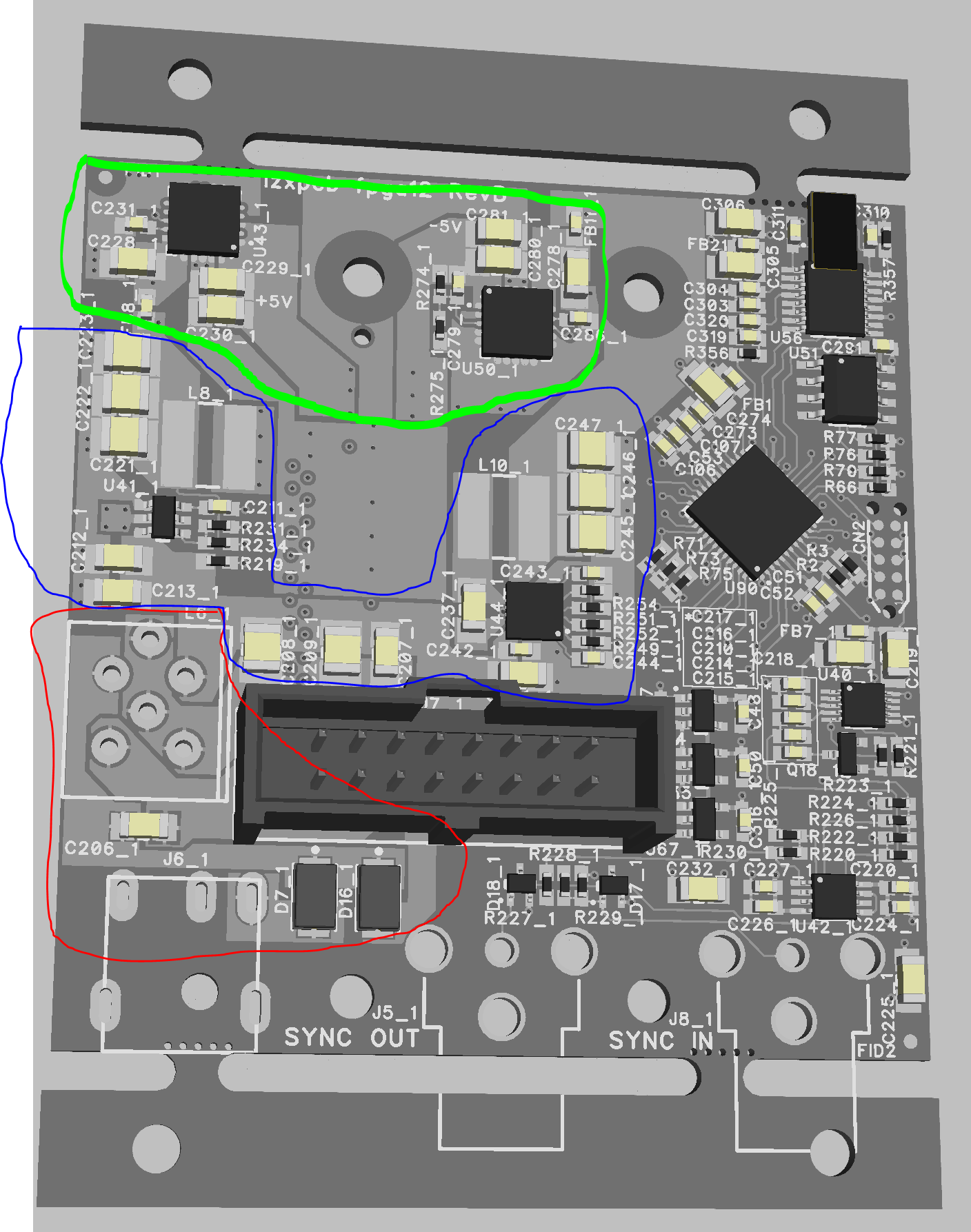
This is the board with the FPGA + power on it, but I have highlighted the power stages. Red is power entry (Euro + DC), Blue is +/-5.5V switching power supplies, and Green is the +/-5V low noise LDOs.
#24 — creatorlars · 2022-01-29
I suppose there’s an important point to make amidst this discussion:
There’s nothing wrong with any DIYers or module makers sticking to EuroRack power connectors only and +/-12V inputs same as you always have, or especially with existing designs. This is more of a heads up that, if you’re selling modules in the future, you might have some potential new users who started with Gen3 and may not have a EuroRack power supply yet. As long as you clearly mark what power connectors are supported, it is not a big issue.
The main question is how does LZX as an entity provide new reference designs that show how to make use of the new power entry options and new circuit designs? How does it serve the community best to handle that? This doesn’t have to be decided immediately, but it’s nice to get the conversation started.
#25 — rempesm · 2022-01-29
The part number for the Bergstak headers you’re using would help and seeing a generalized pin out for them, too.

#26 — creatorlars · 2022-01-29
We do have source files prepared for a release, we just wanted to get through the launch of the first 5 modules before doing an official release. But I can at least share part numbers and pin outs.
This is on the bottom side of the power entry PCB. This shows the fpga12’s full pinout, but the main things you’re looking for are the +/-5V and GND output power connections.
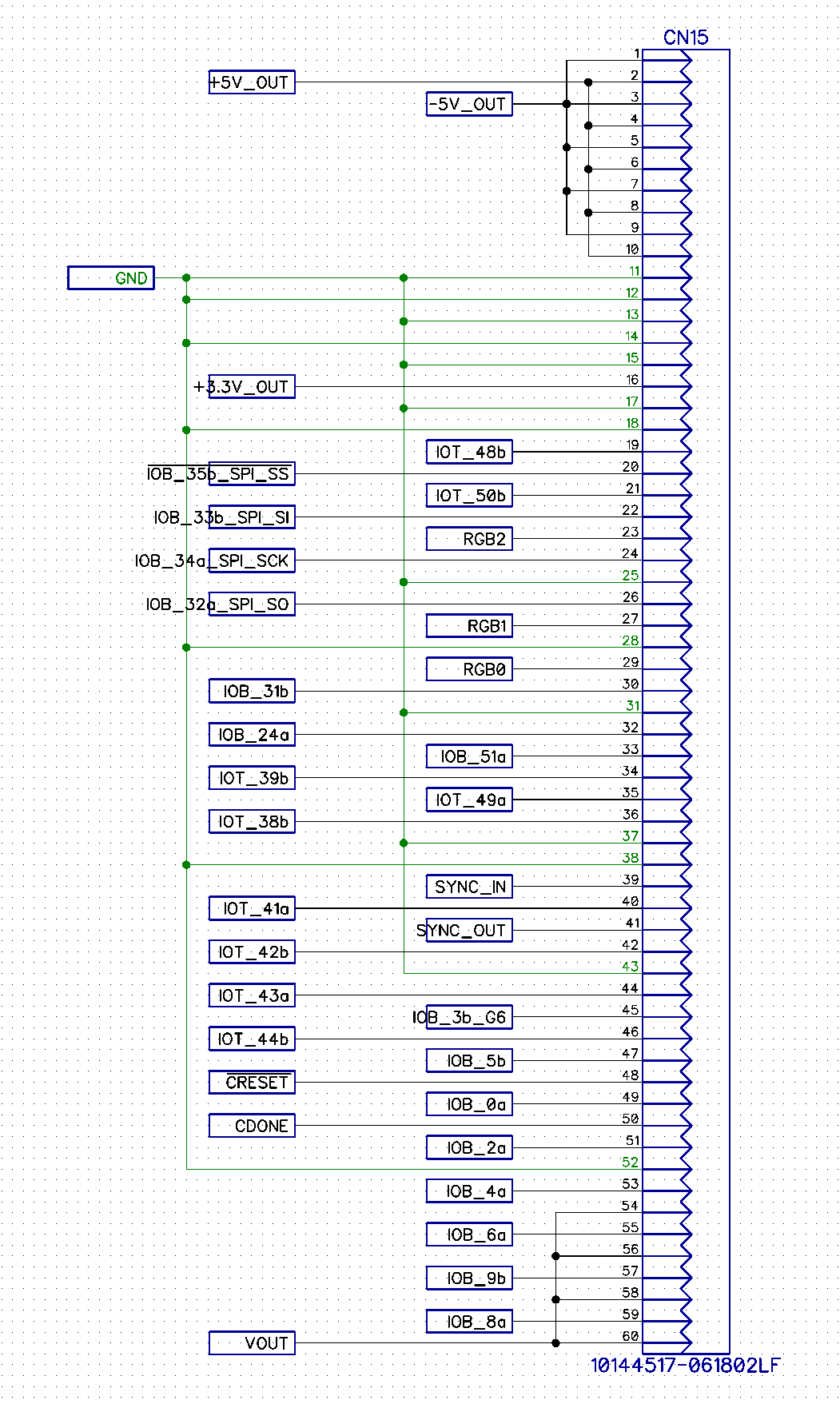
LZX power entry PCB connector: 10144518-061802LF
Your custom host board’s connector: 10144518-064802LF
These are the only 2x header partnumbers used on any Gen3 module assembly. There are some height variants that are compatible, you can see the full matrix of options in the Bergstak datasheets. With these exact partnumbers the mounting height between boards is set at 8mm. We use M3 8mm brass standoffs at mounting points both above and below the connector to ensure robust contact between connectors. So you’ll need some dimensional data as well. We’ll get all of this together soon.
#27 — rempesm · 2022-01-29
Super kind of you to share any of this info early and look forward to the OEM power backpack releases when the time is right.
#28 — creatorlars · 2022-01-29
OEM power backpack releases
I think ultimately that’s the next step! Once we open that up, the DIY community and other module makers can find ways to use this board in ways that I can’t quite imagine yet, because I am working within the context of maintaining a core product line.
Do we have anyone experienced in KiCad and/or Eagle who would be interested in helping prepare template PCB files for assemblies that would use the hosting connector? We are all Diptrace here, and it would be good if the release included a few other CAD packages in its example files.
#29 — Fox · 2022-01-29
Do you mean library files for importing the assembled backpack as a whole? I use Eagle exclusively.
#30 — creatorlars · 2022-01-29
Do you mean library files for importing the assembled backpack as a whole? I use Eagle exclusively.
Right, it would be good if someone who uses Eagle could take our Diptrace board file for a “host template PCB”, and convert or recreate it in Eagle. Possibly set up an EAGLE source library for LZX parts based on the Diptrace ones. (For this particular board, the only part is the connector.) That way we have a confirmed reference project in Eagle format as part of the public release. I worry about providing nothing but Diptrace source files for less experienced tinkerers who may want to use the template file. If you’ve got some time and want to help, shoot me a message.
#31 — homegrown · 2024-07-25
I could certainly help with this on the Kicad side if there is still interest in that