Performative, tactile control via kobs and sliders
Category: Unknown · Tags: — · Posts: 37
#1 — dryodryo · 2022-05-29
Hi,
I want to have a conversation about the design of audiovisual instruments with regard to tactile, hands-on performance. I would like to hear some artists and designers’ thoughts about this. How important or desirable is the ability to move a control quickly, with a musical feel?
The entire reason for the resurgence of knobs and sliders in synth design is due to the lack of intuitive controls seen in late 20th century instruments exemplified by the notorious Yamaha DX-7. Moreover, many artists have embraced hardware audio and video synthesizers precisely because they want the responsive tactile interface of knobs and sliders that can be difficult to achieve via PC software.
And yet, so many synths and modules, both audio and video, are designed with potentiometers that literally introduce friction into the performance. The pots resist being moved. It is not possible to use these pots as real-time parameter controllers in the same way one would use a musical instrument. The pots are just too slow to be moved as quickly as one’s hands can move.
This goes against my entire working methodology. I learned synthesis on Sandin, E-mu, Buchla, ARP, and Sequential Circuits gear, all of which have frictionless pots. (The E-mu modular in particular was a joy to work with, all-metal modules and knobs that were perfect for real-time manipulation.) I’ve also used gear that had slow and sluggish pots, e.g. Hearne/EAB, Roland. While I loved the fucntionality of those instruments, I was not a fan of their performative characteristics.
My current rig has modules from ten different manufacturers. Almost all of them use pots that resist being moved. I do not fully understand this design choice. Why would anyone want to undermine one of the key functions of hardware synthesis – real-time tactile control?
Is it because the available OEM parts are all designed this way? No, because there are some pots that don’t introduce friction. In particular, the @brownshoesonly modules use pots that I can move quickly and easily in a staccato motion, or move slowly and evenly in a legato motion. I think Nick gets it. His experience with live bands has informed his module design with musical performance in mind. I love the oversized knobs, as well. Yes, I know the V.HS modules are going to be more compact, and I guess that means the end of the big, sexy knobs that are so great for musical performance.
Are most pots slow and sluggish to prevent accidental changes from bumping the knob or slider in a dense forest of controls and cables? This does make sense to me. Eurorack real estate is extremely dense in comparison to historical designs. (The E-mu modular was huge, with vast swaths of empty space. Great for performance, but absolutely not portable.)
Knobs and sliders that are difficult to move are great for “set it and forget it” applications. Is that the dominant paradigm? Is the assumption that artists are going to set up a patch and let it run with little or no real-time manipulation? There is merit to that, but it shouldn’t be the only option.
Finally, I want to bring up the FKG3. Not having an ESG3 yet, I can’t fully test the new keyer module. But I have seen video demos by Nick and Johnny Woods. The Threshold pot has a fixed slew function built into it. This assures a “smooth” transition between key thresholds. I humbly suggest that this design choice does not take all use cases into consideration. One of my most favorite things to do is “ride” the key threshold; to play it like a musical instrument. This slew factor makes that impossible. It’s like someone built a musical keyboard that had a fixed portamento that was always on and could not be disabled. Or an envelope generator that could only produce slow attacks.
I’m really, really not a fan of the visual effect of changing the FKG3 threshold. It’s got a very robotic feel to it. By analogy, it’s like a computer animation that uses the default slow-out, slow-in Bezier tangents. This is something that only beginner rookie animators ever do. The very first thing one learns is how to adjust those curves to make the animation natural, interesting, believable.
I’m assuming that the Threshold CV input of the FKG3 does not have a slew on it, otherwise it would be useless at any frequency above one Hertz. So I can use an external controller to get the effect I want for this parameter, or any parameter that has a CV input. (My favorite is my trusty JL Cooper CS-10^2, a MIDI controller from the early 90’s that has nearly frictionless 110mm sliders.) But in a perfect world, I could use the physical controls directly built into the modules, and not have to resort to external gear and the ensuing greater patch complexity.
In future LZX designs I would like to see the tyranny of enforced slew rates abolished. I would much rather have full manual tactile control over the parameter than have to live with “smooth transitions”.
Thoughts?
#2 — rempesm · 2022-05-29
Do you mean like a korn kob?

#4 — Rik_bS · 2022-05-29
As the Euro world moves to compact, dense, feature-rich modules I would expect to see more CV control surfaces on the market.
For that is one of the benefits of modular, if a design choice doesn’t suit your use you can build/patch options that do.
I’ve planned a “control skiff” to use as the playable surface that sits on my desktop, to be patched in to the a/v racks that will stand vertically on a shelf.
Perhaps you could consider that option, and if you go DIY it’ll even allow you to choose the knobs that feel best for you.
#5 — reverselandfill · 2022-05-30
those big blue multiturn type potmeters are fantastic to play with. smooth and precise control over the parameters.
But I have not yet found one that can be mounted such as the 9mm Alpha vertical pot.
And they are super big / tall. (and expensive)
#6 — dryodryo · 2022-05-31
I’m down with control surfaces, both analog and digital. But I also want more module manufacturers to recognize the value in prioritizing responsiveness. For example, LZX Gen3 knobs feel great. Really f’n rock solid. Detente position is unmistakable, it just FEELS RIGHT. Knobs rotations are secure, they’re not going to move if bumped. But they are impossible for real-time staccato movement, it just can’t be done. And if there’s no CV input, things get really complicated. Now you need not only an external controller but a VCA just to get that performative feel that’s lacking from the module’s onboard controls.
#7 — reverselandfill · 2022-05-31
You have to understand that not all people will want this type of realtime staccato movement out of knobs.
#8 — nerdware · 2022-05-31
Yes, I find that, if I want that kind of chaos, I can get it using modules designed to produce chaotic CVs. They may be designed for audio, but they also work for video animation.
Nevermind the various modules and other devices for turning hand movements into CVs without knobs.
#9 — nerdware · 2022-05-31
BTW, I’m currently transforming my video synth into two cabinets. Cab 1 will be the animation cabinet (mainly non-video modules). Cab 2 will be the core video synth (entirely Gen3).
Here’s an example of what I think an ideal animation cabinet might look like (for circuit-bending values of ‘ideal’):
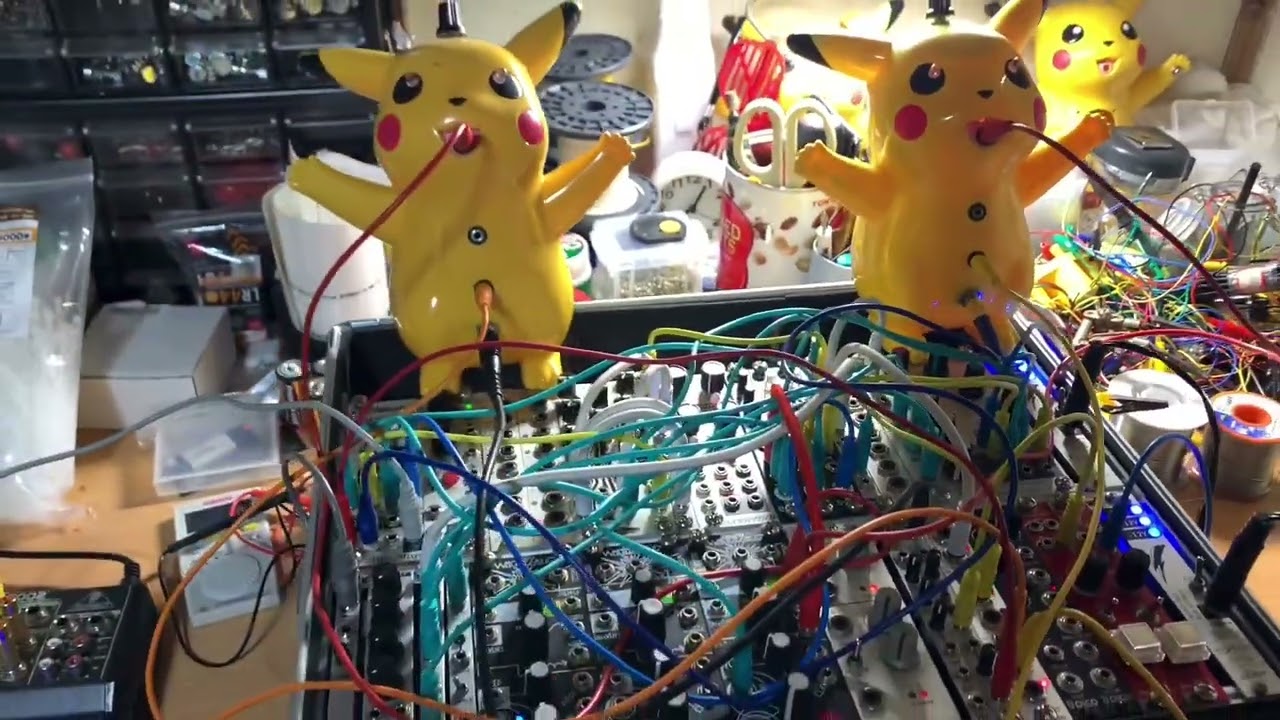
https://www.youtube.com/watch?v=0L5t5IBBLIAPlease note the triple Wogglebugs! Imagine the CVs going into video modules. However, I’d be happy with a pair of Benjolins and Sensory Translators. (I’m currently one Benjolin short. That may change.) Benjolin videos with constant knob-twiddling make me feel sick, but I love the self-modulating videos. This may also apply with videosynth videos.
Maybe some of us are more process than performance.

#10 — Vdot · 2022-05-31
I don’t disagree that it’s fun to have looser pots for performing but at the same time, on a modular with a bunch of cables snaking around the knobs, it would be hell trying to keep a patch in check without pots changing values due to cable friction.
My vote is for keeping the resistance of pots as is and convincing one of the fine DYI designers to create a 0-1v voltage offset generator/VCA module with a big, low-friction performance knob. I’d also like a DJ-style RGB cross-fader while where at it.
#12 — creatorlars · 2022-05-31
This is a pretty hot take! I’ll respond with a couple points.
- Video is naturally quantized to the frame rate, creating a frequency division between the image and the animation/movement of the image. There’s an upper limit to how fast you want the knob to move to not disturb the image, and that’s about 33ms for SD video.
- The intention of slewing the bias pots and and the control pots for active (dual VCA based) attenuverters is to remove noise that can bleed into the image due to the potentiometer aging or due to fast, staccato movements that may disrupt the content of the image itself (transients that move faster than the frame rate.)
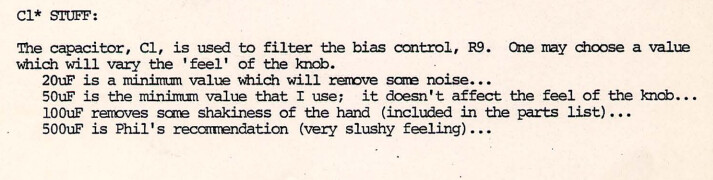
Here’s a quote from the Sandin IP distribution religion document, page 13 for the Adder Multiplier – this gives us a historical glimpse into this issue from the first generation of video synth performers:
-
The FKG3 threshold control is slewed more heavily than the general slew on Gen3 controls. Judging from the above list, it is a “100uF” option, whereas our typical slew is more like the “20uF” option described above. This is a performance minded feature that was arrived at after many years of reflection. With a keyer threshold during live performance, if you want sharp threshold transitions you would typically modulate the threshold with a stepped control source. If you are adjusting the threshold manually, you are typically intending to create a transition. This threshold transition reveals a range of intermediate frames that create the impression of motion. Even if you are moving the knob fast or to a beat, this still works out to your advantage as you will be revealing all those intermediate frames in time to the music, creating a cycling animation. If you want stepped or sharp transitions, there are better tools for that job, like frame rate clock dividers or frame-quantized pseudorandom/S&H.
-
FKG3, despite it’s name, is not the same module as the Visionary TVFKG at all. FKG3 is a “Color Component Keyer” and TVFKG is a “Triple Crossfader + Triple Comparator”. One is a complex single function, and the other is six discrete simple functions in a semi-modular arrangement. If you look at the mathematical models for how each works, it should reveal the reasons for this. I would still like to do a “Triple Crossfader + Triple Comparator” or equivalent modules, but the single function “Component Keyer” is an important building block that I feel empowers some important core workflows in a single step up front. So that’s why it is where we started in Gen3.
Modular instruments are full of both complex integrated single functions and discrete raw functions. From an instrumentation perspective, both are important to conceptualizing and patching video processing workflows. The “fader” or crossfader is a great example of this. Under the scenes, this is a complex integrated function involving a Dual VCA, one being driven high while the other is low, controlled from a single CV source. But if you had to patch every crossfader out of dual VCAs and summing blocks, this becomes laborious – which is why a fader/crossfader is an important instrumentation building block.
More examples of complex single function blocks in a video synthesis workflow:
- Colorspace converters (triple fixed gain summing amp)
- Polar to cartesian transform (combo of dual VCA, dual sine shaper, quad rectifier)
- Rotation/affine transform (quad 4-quadrant multiplier, dual summing amp)
- Gamma (log/expo shapers and dual VCA/crossfader)
- 3x3 CSC/Matrix transform (SMX3, for example)
In these kinds of posts in the future, it would be quite helpful to be shown a practical demonstration of the issue, along with a video recording. I can perhaps reveal some context that may help you understand the instrument in a way you have not yet considered. Discrete measurements are also helpful, such as “I have measured the slew to be ~500ms and would prefer something close to ~100ms”.
#13 — jwsmithwick1 · 2022-05-31
So I think that your FKG3 might be malfunctioning. I purchased an early one and the softness knob stopped working properly. I took some captures and contacted @Z0NK0UT. He saw the captures, emailed me an RMA, and within a week I had my module back. I was shocked at the return time.(

) The FKG3, more specifically a system with multiple FKG3’s is amazing. That module is one of my favorites.Truth be told, I prefer stable knobs. I like using something like a Instruo 2[f] for performative techniques because any damage I do will be to the (less expensive) controller module. It really seems like maybe you should go the DIY route and make your own controller. Then you can make something with the knobs that you want. Or, you could find a midi controller that you like and convert that into 0-1v
If your FKG3 is working fine, and you’re still unhappy with the threshold response, maybe premix the Threshold cv? VH.S submix might solve your sloping issues as well as the one you have with knob friction.
#15 — nerdware · 2022-05-31
The impression you get may be shaped by the videos you choose to watch. I tend to avoid videos with rapid knob twiddling and endless camera movements. I have no difficulty finding videos that satisfy my tastes, but I know I would also find many rapid knob-twiddling videos without any trouble. This is just my selection bias.
#16 — dryodryo · 2022-05-31
Lars, I totally understand your design intent, I just don’t agree with a lot of it. Really the only part of your post that I can fully get behind is slewing the pot input to eliminate noise from dirty or aging components. That is definitely an issue, I saw it with both the IP and the EAB.
I really strongly disagree with the idea that transitions (e.g. key threshold) need to be slowed down for performative reasons. I know you’ve thought about it. I know you have years and years of experience. But I also know that you are open to user ideas. And from my perspective, it’s a bug, not a feature. The musical performance I seek likes in the gap between your slewed pot and an external stepped voltage.
As for the assumption that there’s no reason to ever make transitions within the frame… no. Just no. It’s completely legitimate to have events take less than one frame to occur. Yes, you get vertical banding. Yes, very sharp transitions will create tearing. But that’s not necessarily a bad thing. And the limitations imposed by quantizing all events to whole frames/fields outweigh the benefits. Just as I was saying about latency in a decoder/TBC … the same thing applies here. I need to have the ability to control whether or not a slew or delay exists.
A product can’t be all things to all people, you have to make utilitarian decisions that you think will benefit the largest segment of your customer base. I’m just trying to offer my thoughts regarding my own needs vis-a-vis the tools, and see what other people have to say.
Thanks.
#17 — dryodryo · 2022-05-31
Oh, and I would love to post video examples… that will be possible soon with the imminent shipping of ESG3. Whoo-hoo!
#18 — creatorlars · 2022-05-31
dryodryo wrote:
The musical performance I seek likes in the gap between your slewed pot and an external stepped voltage.
How fast can you sweep the knob full scale, in milliseconds? Let’s get this quantified so it becomes an engineering question of “how far off is the FKG3 threshold slew from your desired performance” instead of a design critique. We can look at that number and I will definitely take it under advisement when it comes to the ongoing system design.
As for the assumption that there’s no reason to ever make transitions > > within> > the frame… no. Just no. It’s completely legitimate to have events take less than one frame to occur.
I didn’t say that, I said that a bias control knob is a poor tool for that job. Moving the knob will always create a multi-frame transition – that’s just how human hands work. If you disagree with that statement, I need some measurements! The slew is there to smooth out that transition (which already exists, when you adjust the knob with your fingers.) If sharp transitions is what you want, you should be modulating the threshold with a mix of square waves. If you want the mid frame glitches, any square wave will do. If you want quantized transitions, you need S&H or square waves divided from the frame clock or VSYNC.
#19 — jwsmithwick1 · 2022-05-31
What are you currently using for an encoder?
#20 — sean · 2022-05-31
I tend to side with the folks that are saying that this kind of feature is something best offloaded into a controller of some sort.
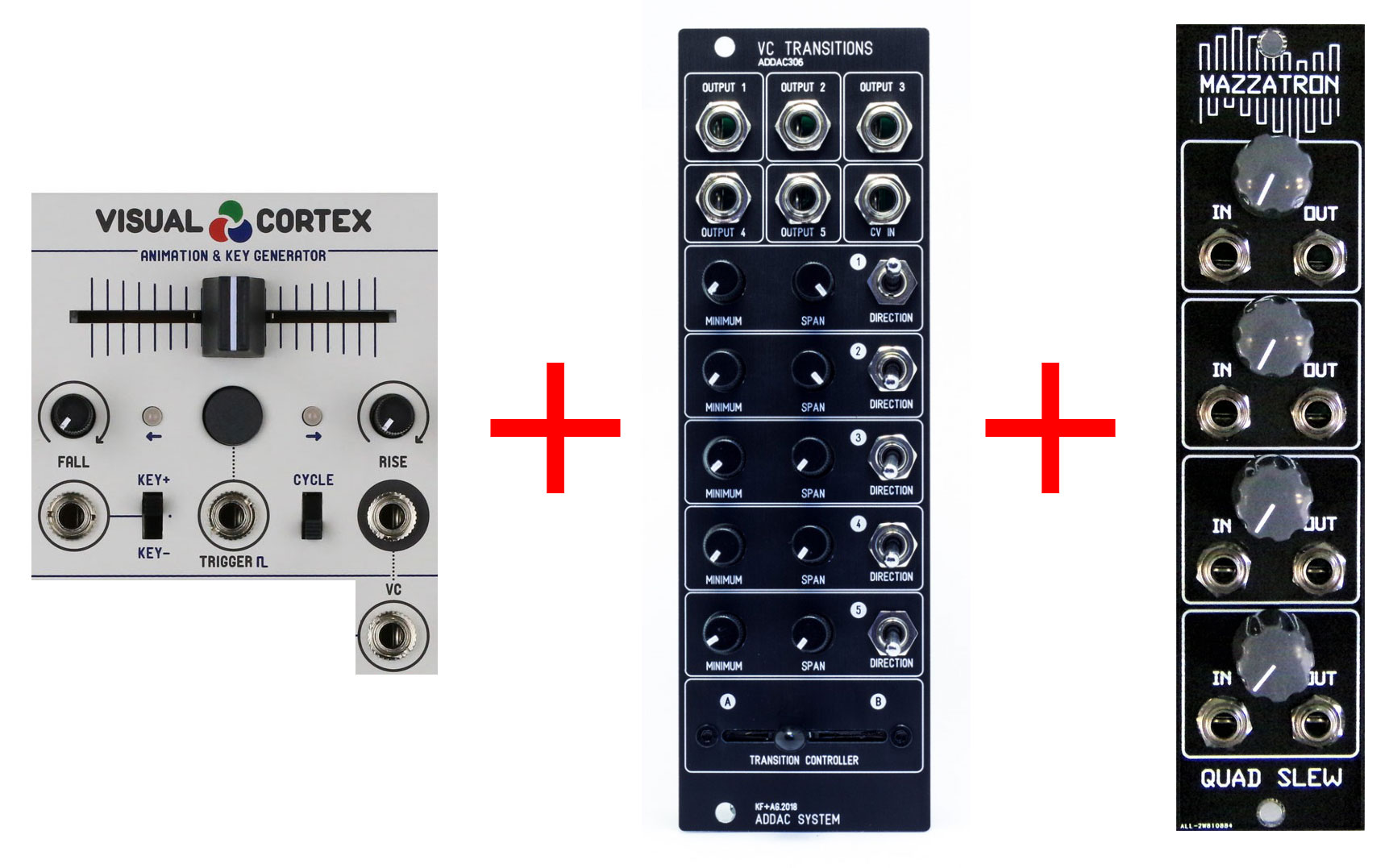
Having a macro control module with some combination of the Cortex transition section (having manual, automated, VC, and trigger options is nice), the multi-routing of ADDAC 306, and control over transition slew — all in a 0-1v range — would be cool.
#22 — dryodryo · 2022-05-31
Hey Lars, I don’t have a way of measuring time in anything less than a second. But I think I could probably twist a frictionless knob from one extent to the other in, let’s say, 250 milliseconds? But then the question becomes, what is the optimal slew rate based on that mechanical limit? And is the slew fixed or variable? I certainly wouldn’t want 250 milliseconds of delay if I was only moving the knob, say, 10 degrees instead of 300 degrees.
In a perfect world, pots would be buffered to even out any mechanical noise, but have zero friction and zero latency. I have no idea if that is technically possible or feasible.
Thanks
#23 — dryodryo · 2022-05-31
I don’t have an encoder at all… been limited to vector graphic tests since I started collecting modules back in October
#25 — creatorlars · 2022-05-31
dryodryo wrote:
Hey Lars, I don’t have a way of measuring time in anything less than a second.
You could try taking a video of yourself turning the knob, and then see how many frames the motion takes, and multiply that by the 1 / FPS, for a rough approximation of period. I think 250ms is probably realistic!
But then the question becomes, what is the optimal slew rate based on that mechanical limit? And is the slew fixed or variable? I certainly wouldn’t want 250 milliseconds of delay if I was only moving the knob, say, 10 degrees instead of 300 degrees.
Slew is rated in V/s, or the increment of time taken for the voltage to rise 1 Volt. So it is already proportional – for example, if we move the knob across 10% of the control range, the slew across that period will be 1/10th the time it takes to transition across 100% of the same control range. So slew is proportional to the knob distance traveled.
Side note: This is different from tweens or animation events (which is another fascinating topic) – where typically you define the transition time independently from the range over which you are transitioning.
So since our control pot moves across 0V to 1V, this makes 250ms a slew of 4V/s.
Since the slew is “moving with your hand” for the reasons mentioned above, its effect on knob responsiveness are going to be transparent if our circuit slew is matched to the speed of your knob turning motion. 33mS or a slew of around 30V/s is enough to minimize glitches that may appear in the image due to resistive noise from the pot.
I’ll get a simulation pulled up and see where FKG3 Threshold sits related to these numbers in a sec, and then compare that to the pots on say, ESG3, and we will have some useful information.
#26 — dryodryo · 2022-05-31
@7pip Thanks for the offer, I’m only interested in HD formats. Otherwise I would have re-entered the modular video world with the Visionary series ten years ago!
ESG3 getting very close to shipping, a little bird told me the serial plates are printed for the first 100 production units.
#27 — creatorlars · 2022-05-31
OK I’m back (had to pick up the boy!)
Here’s a graph of the existing FKG3 slew circuit across a full scale knob sweep time of 250ms. We’re actually looking pretty good, by that metric – but just shy of your ideal response curve.
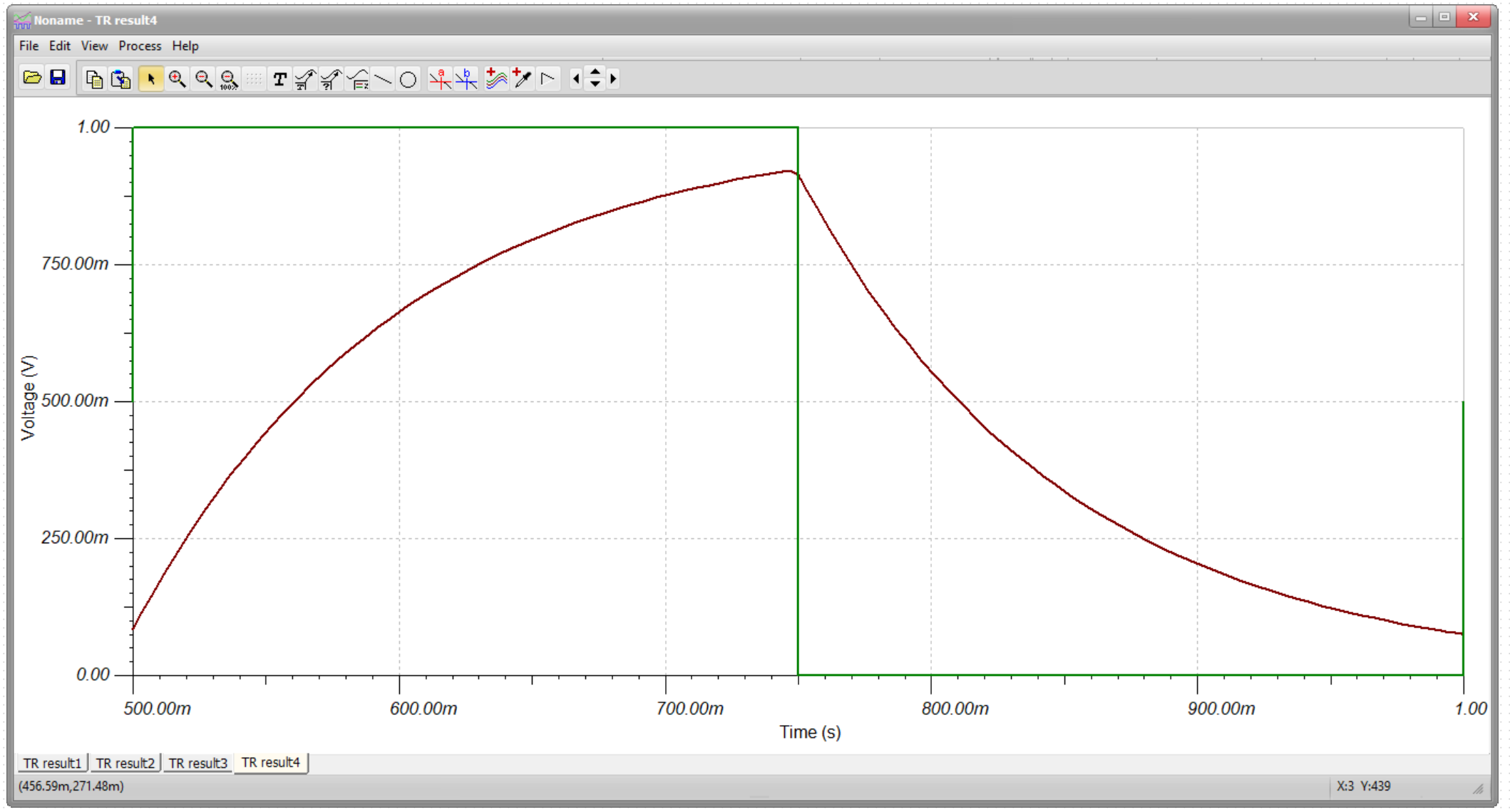
Here is the same time constant, showing the amount of slew on other pots in the Gen3 series modules:
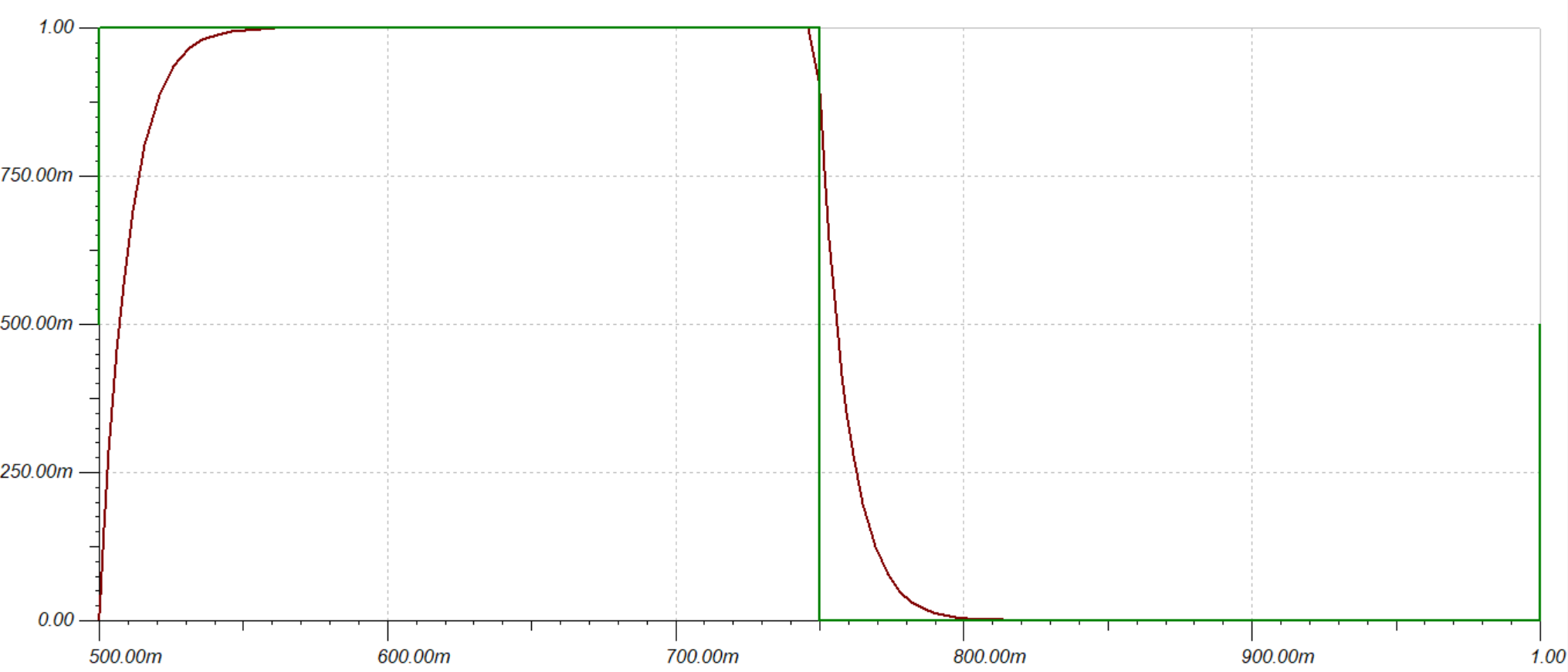
So you can see, there’s quite a difference – but the first curve is still matched pretty closely to something reasonable as the human limitation on response speed. The second curve should be more or less invisible, just “silky” rather than slewed.
If you want the second response curve, replace R58 on the middle PCB assembly (lzxpcb-fkg3-core) with a 1K resistor (previously a 10K resistor.)
#28 — dryodryo · 2022-05-31
Thanks for taking the time to look into this. I will have a better sense of what’s happening when I get the ESG3. But all I can say right now is, based on watching Nick’s Twitch demos, the key threshold pot has what looks like a slow-in, slow-out rather than a linear response. And it looks like the onscreen motion is still going after the mechanical knob motion is complete. I’m happy to set this aside for the moment until I can get you some more concrete feedback.
On a positive note, the mechanical motion of the pots is good. Very little friction on the Threshold and Softness pots, lots of friction on the CV gain pots. That part of the physical design was definitely optimized for performance and stability.
Thanks again, I really appreciate the “hands-on” approach!
#29 — creatorlars · 2022-05-31
dryodryo wrote:
On a positive note, the mechanical motion of the pots is good. Very little friction on the Threshold and Softness pots, lots of friction on the CV gain pots. That part of the physical design was definitely optimized for performance and stability.
Right! I like that too. The detented pot is really a 2-in-1 scale – since you have a full sweep on either side of the detent. So I like the greater friction there – if you are going by haptic feedback (eyes closed), you can “feel” the sweep range this way … more friction = smaller range, less friction = wider range.
#30 — creatorlars · 2022-05-31
dryodryo wrote:
the key threshold pot has what looks like a slow-in, slow-out rather than a linear response.
Right – that’s what a simple RC filter looks like – same as the slopes above. A “performance slew” with different curve options and adjustable time constant is something I am planning to merge with audio envelope follower functionality on a future module, as that is a natural fit.
#31 — Rik_bS · 2022-05-31
Cab 1 will be the animation cabinet>>>> …>>>> Please note the triple Wogglebugs!
ahh yep, this is my planned Control Skiff - already have the modules and rails, just need to make time to build the case. Note the NLC modules, chaos is way more interesting than random

going back to the original topic, I’m typically not a fan of “played” audio and video, where the control being interacted with is directly audible/visible in the performance and you can see their movement directly translated - much prefer at least one step of separation. ie having a slew or envelope between the human and the modulated signal, or the LFO speed being increased which then changes the way the filter or VCA is processing the signal.
That might be because I prefer slow, droney, meditative A/V experiences - and too many times the direct human control makes the performance feel “adjusted” rather than “performed”
#32 — dryodryo · 2022-06-01
@Rik_bS That’s a great observation… if we talk about visual music concepts, the “Mickey Mouse” effect is always a concern. That’s the question of whether visual and audio should be in sync or not. If you want tight synchronization, it had better be tight. That’s what I’m on about regarding the tactile response. But even if one is trying to achieve a counterpoint to the musical rhythm, one still needs a reliable, responsive control.
#33 — creatorlars · 2022-06-01
Rik_bS wrote:
That might be because I prefer slow, droney, meditative A/V experiences - and too many times the direct human control makes the performance feel “adjusted” rather than “performed”
That’s my experience as well – those small motions when you’re dialing in the sweet spot, having a little slew helps you guide the voltage into place transparently instead of it looking like a series of nudges. With feedback especially, a nudge can end up rippling down through your feedback chain quite obviously even when you’re operating the knob with care and uncaffeinated. So the end effect for me is the slew provides more control, not less – it’s meant to satisify a design goal of “maximize the usability of hands on controls.”
@dryodryo I’m incredibly interested to get your second take after trying the module out in context – once your fingers are on it, adjusting the threshold of a video key in time to a musical track, doing what’s instinctive to you as a performer, I want to know if your thoughts change at all. You will probably feel the same, if it’s something that’s already bugging you, but it’s a nice case study.
#34 — dryodryo · 2022-06-01
Thanks Lars, I totally get what you’re talking about regarding the super sensitive nature of some patches and effects such as feedback. That’s definitely a case where smoothing out the user’s motion is helpful. In the case of more extreme / fast / staccato playing, the smoothing is a deal-breaker.
The other issue I have is the non-linearity of the response. To the best of my ability I rotate the knob at a linear, constant speed … but the system decides to accelerate out of, and decelerate into, its resting state. Not gonna work for me, sorry.
If you do build a slew module I would love to have one in my toolkit. I have some Pulp Logic ones which are pretty nifty, but choices for different types of curves would be wondrous.
#35 — reverselandfill · 2022-06-01
I read your flagged comment.
What I meant with my comment is that as a developer , I cannot cater to all needs.
And the pots are not interchangeable, so it is not that easy to fix.
edit: I found this one: P260T looks like it has the same footprint as an Alpha pot… though expensive.
Musicthingmodular make the “Control” module, which uses those. (but has no 0-1v output)
Personally, I try to make my modules affordable, and such fancy pots are definitely not. (+10 euro per potmeter) unless…
You already inspired me to think up a module with those smooth multiturn / or singleturn blue potmeters mounted with a large round custom made knobs. precise voltages…
#37 — creatorlars · 2022-06-01
DesertMuseum wrote:
After reading through some of the correspondence here it seems to make sense that maybe there should be some slew in order to make the knob moves smooth…?
That’s correct – the time constant of knob turn speed vs. the frame rate of the video signal is an existing constraint – it’s a design consideration with any video synth design. Actively buffering the pot and adding a slight slew to the voltage is a layer of polishing that we’ve put into all designs since Topogram. It’s not a feature that is required to make a good video synthesizer, or some part of the shared LZX patchable standard, but we feel like it adds an extra level of performance and signal integrity to our instruments specifically.
It seems like we got the slew constant right with Topogram and SMX3 (also applicable to ESG3 and everything else) – but that with FKG3 it’s applied in a way that some people like and some people do not. It’s likely we’ll revise FKG3 to match the slew constant of the other modules in a future revision.
So to be clear, and re: consistency – FKG3 is the only module which has a more liberal slew applied. The others do not. If you like the way your Topogram and SMX3 feel, that’s what to expect in the future. To my knowledge, there should be no differences in that slew constant between different FKG3 assemblies. To ascertain what you’re seeing between your units, I need a measurement or number of some kind. “This one slews half a second, this one takes two seconds” is a huge difference for example, representing an RMA scenario, whereas “this one slews 450ms and this one slews 480ms” is well within tolerances for the components used.
#38 — creatorlars · 2022-06-01
DesertMuseum wrote:
All this being said, I just want to express my admiration for > @creatorlars> ability to hear all of our user feedback (which is not an easy task) and gracefully channel it into a productive and educational conversation and the willingness to break it all down in order to make adjustments moving forward.
To be clear: your modules are machines – they are engineered to fulfill an elegant balance between specific performance, usability, manufacturability, cost and form factor requirements according to their stated functions. There’s a lot of passion behind the design of these modules but the passion is in fulfilling those requirements to the best of our abilities. In product design, everything is a balance. We’re always happy to receive feedback related to how well that job has been accomplished, and also how well those design requirements were determined in the first place.
But sometimes those aren’t the same thing – for example, if you expect 0.1% linearity and 0.1% tolerances, well we’d have to design a more expensive product for a different market to accomplish that. Best we can do at the “prosumer instrumentation” price point we target is a stack up of tolerances around 1%-2%. Or form factor constraints – for example, while a 4HP TBC or 4HP Ramps module seems like it would be good from a usability perspective, we’d have to sacrifice too many other aspects of our standard (mounting depth, power draw per HP, rear connector usability, etc) in order to accommodate that – a great case in point is modules that fit in one case but not another. So these are examples of feedback that, while we appreciate it, are an area we have to stand our ground and focus on delivering consistent performance.
The useable kind of feedback for us relates to practical experiences with control ranges being off or out of tolerance in certain use cases, or things like too much slew on a pot (like this post.) Or functions you wish existed that don’t yet exist in the landscape, etc – for example, it’s hard to use a module because there are no other modules that are its “other half.” That’s very useful kind of feedback and it just helps us do our jobs better.
#39 — dryodryo · 2022-06-01
I can’t believe my mildly sarcastic comment got deleted. I mean really, there’s a big difference between friendly banter and abuse. It’s a moderator’s job to know the difference.
But apparently there’s no room for humor or irony here. I’ve run afoul of it several times now. Fine. Just the facts from now on. Next time someone makes a mind-numbingly obvious comment, I will just ignore it.
Peace out
#40 — reverselandfill · 2022-06-01
sarcasm can be hard to ready as plain text.
but I did not flag your post, so don’t take it out on me.
And as I tried to explain, my comment was not meant as “mind-numbingly obvious”.
Your post comes over as a wish for developers to take seriously.
As a DIY developer, it might be a possibility to offer options for different pots (stiff or smooth rotation)
This is something I had never reseached before, because I assumed it was not available.
But it appears it is.
edit: let’s continue with the discussion.
#42 — brownshoesonly · 2022-06-01
FYI, the twitch streams should not be cited as references in terms of timing. example above, I move a control and then watched the output.
The stream is not in “sync” to that kind of level. Cams and synth output go through different chains and equipment. mostly the video feed from the LZX goes through the BMD web presenter and then meets up with cameras going directly to OBS.
This is especially noticeable on audio reactive streams. (i think only one). until we get some of the feeds more in line.
#43 — dryodryo · 2022-06-03
Thanks Nick, that is a very important point!
Loving your Twitch streams, but usually can’t participate in real time because work. Monday through Thursday, I’m slaving over a hot 3D workstation until 7pm. Fridays, I’m usually exhausted.
#44 — dryodryo · 2022-10-25
Crypto-bumping this thread to say I’m loving MATTE. There’s very little slew on the pots. Just enough to avoid noise? But not enough to interfere with real-time performance. So for any parameter with a CV input, MATTE solves this design issue.
Case in point: FKG3 Threshold. The Threshold pot has mad slew, like a half second. But patching MATTE into the Threshold CV makes it possible to “ride” the parameter in a real-time performative sense, with very little slew.
Thanks!