LZX Module Releases Preview 2022
Category: Forum · Tags: — · Posts: 96
#1 — creatorlars · 2022-06-06
Over the course of the past year of development, a few new module designs were added to the Gen3 roster.
Most of them are simple utilities that expand the techniques possible with the initial set of five.
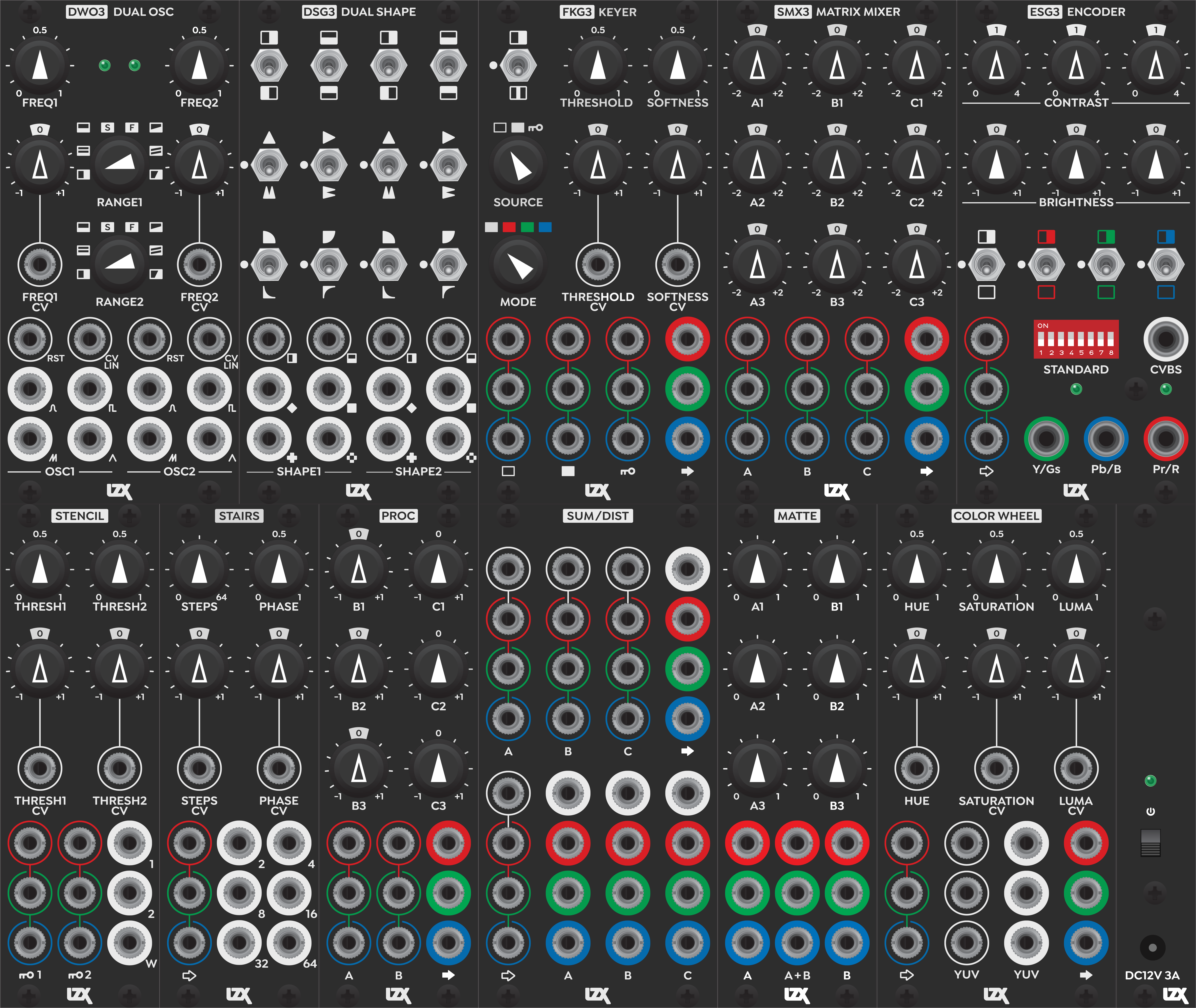
– Stencil is a dual luma hard key generator (extract flat regions from all those DSG3 shapes).
– Matte is a dual RGB offset generator (turn FKG3 into a colorizer). Our simplest module to date, but an important part of the system.
– Stairs is the update of our multi-stage wavefolder/rectifier Staircase (Expedition). It adds a 6th stage and offers an RGB/Luma input option.
– Sum/Dist is a quad summing amp + quad active mult/distribution amplifier (versatile signal routing for a growing system). It shares functionality with Bridge (Expedition)
– Proc is the new version of Triple Video Processor (Visionary) and Passage (Expedition).
– Color Wheel is the new version of Mapper + a Chroma rotator, and was developed in order to test one of the Chromagnon subassemblies in isolation from the rest of the hardware
I don’t know when we’ll be releasing these, but I wanted to share some progress and generate some discussion.
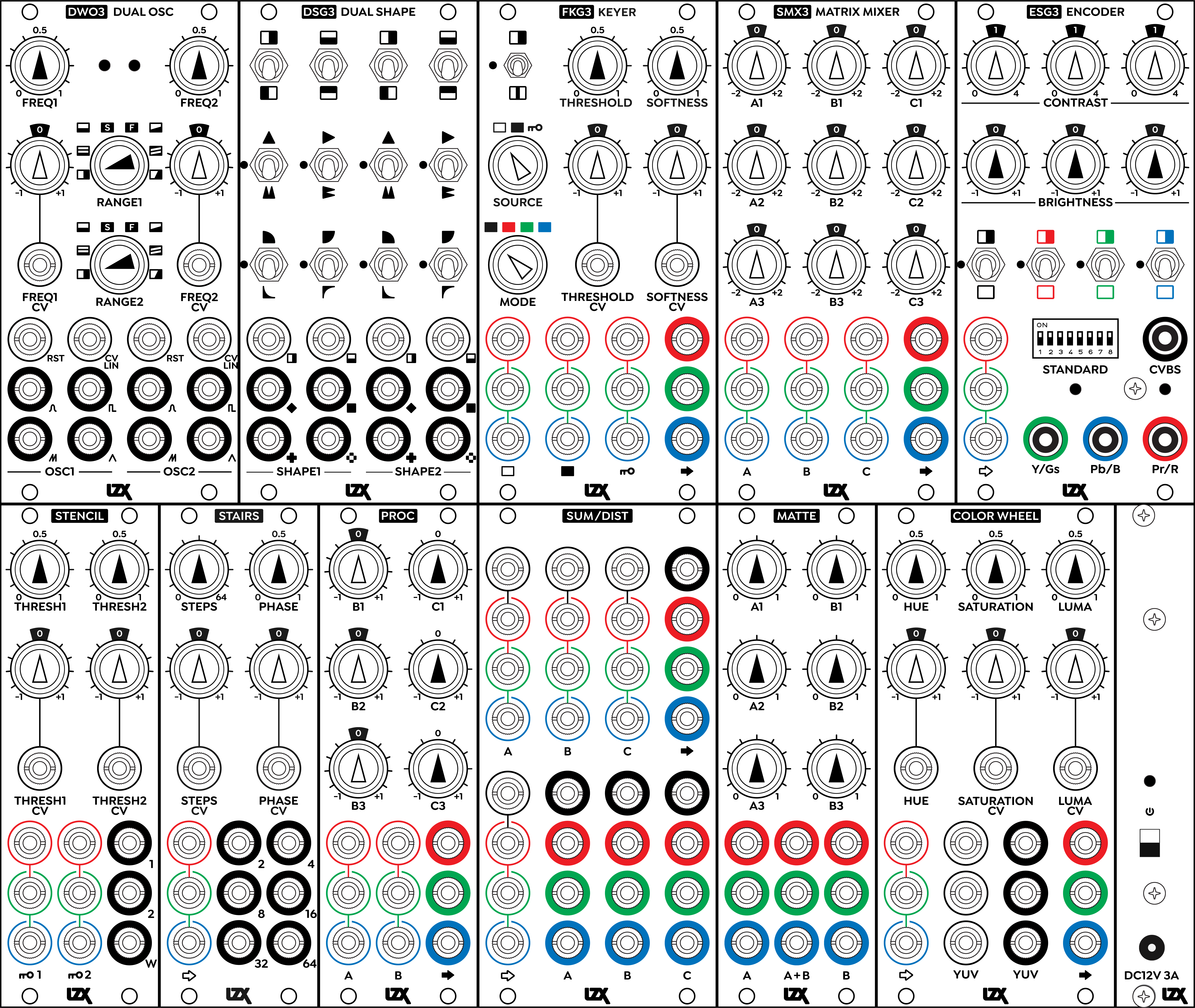
Here are some illustrations of the growing lineup, including the five initial modules.
#2 — wednesdayayay · 2022-06-06
woohoo! thanks for the update
what is the W output on stencil for?
do any of these new modules take sync input?
I’m glad to see that passage is getting a spot in the new lineup it is such a workhorse module.
what kind of price point are you shooting for on the smaller modules? If it still isn’t clear no worries just wondering.
I’m pumped to have an offset generator in the LZX format. Would you care to expand on how this makes the FKG3 into a colorizer? Are we just talking a video into an input and a RGB out from matte into the other channel then just using a key based on the incoming video to replace that part with whatever color is generated by the offsets on matte?
with one matte you could have a triple passive external triple joystick module that could be hooked up for use within the system. This is something I’ve been thinking about for a while just a simple 1v generator for some more joysticks in the system. I already have my joysticks ready to go just need to find a case and solder up the I/O! I like the idea of using matte because then you also have the A+B outs to further influence the system.
Mapper(plus sanding function generator) was the cornerstone of our system for a long time and I was banking on an update coming out. I’m so glad to see it coming back.
The knob caps make the gen3 modules so much clearer at a glance with the filled and unfilled indicators.
are these modules going to have the fun naming conventions like the previous gen3 modules? Like ESG3, FKG3, DWO3 etc?
RE color wheel what happens when you have RGB and the YUV inputs patched at the same time?
#3 — creatorlars · 2022-06-06
wednesdayayay wrote:
what is the W output on stencil for?
Window (it combines the two key outputs)
do any of these new modules take sync input?
No, none of these require sync IO.
what kind of price point are you shooting for on the smaller modules? If it still isn’t clear no worries just wondering.
We haven’t figured that out yet, but I expect the price-to-HP ratio will remain pretty consistent with the first five. Some of these will be lower due to a lack of video rate parts (like Matte.)
I’m pumped to have an offset generator in the LZX format. Would you care to expand on how this makes the FKG3 into a colorizer?
Matte can be patched as Foreground / Background colors to FKG3. If you patch your video source to FKG3’s key input, this creates a 2-band linear colorizer with both color controls and threshold controls.
You can then expand on that…
2x matte + 3x fkg3 is a 4-band linear colorizer
3x matte + 5x fkg3 is a 6-band linear colorizer (more than the Scanimate!)
You may want Sum/Dist as well in a rig like this, to distribute the key source to multiple key generators in parallel
wednesdayayay wrote:
are these modules going to have the fun naming conventions like the previous gen3 modules? Like ESG3, FKG3, DWO3 etc?
We dropped the acronyms for these.
RE color wheel what happens when you have RGB and the YUV inputs patched at the same time?
The two will end up summing together before the colorspace modifications occur. So you can use RGB in, YUV in, or both.
#4 — sean · 2022-06-06
creatorlars wrote:
RE color wheel what happens when you have RGB and the YUV inputs patched at the same time?
The two will end up summing together before the colorspace modifications occur. So you can use RGB in, YUV in, or both.
Ah, but you can’t do RGB in, send YUV out for processing, and then put YUV back in for conversion back to RGB in a single Color Wheel? It would require two to do this (without feedback)?
Not a criticism per se, just trying to understand signal flow.
#5 — creatorlars · 2022-06-06
sean wrote:
Ah, but you can’t do RGB in, send YUV out for processing, and then put YUV back in for conversion > > back> > to RGB in a single Color Wheel? It would require two to do this (without feedback)?
It is an HSL modulator with both RGB and YUV input options. So you could use it as a converter, but it’s quite a bit of circuit for that use case alone! An RGB/YUV cross converter is a good candidate for a future 8HP module. (In fact it may be a good idea to do both at the same release timing.)
Chromagnon of course is the big sibling to Color Wheel – combining multiple internal colorspace converters, an expanded vector processing core, an auxiliary modulation vector bus, etc.
#6 — sean · 2022-06-06
8hp RGB → YUV & HSL and YUV or HSL → RGB cross converter could be even better!

#7 — creatorlars · 2022-06-06
8hp > > RGB → YUV & HSL> > and > > YUV or HSL → RGB> > cross converter could be even better!
That would be nice, but the HSL modifier is at least a 12HP module with a piggyback/core assembly (so maximum size stackup for gen3!) YUV/RGB converters can fit on 8HP without issues and are relatively inexpensive to implement.
#8 — sean · 2022-06-06
Gotcha. Fair enough!
Honestly not even sure how useful these cross-colorspace conversions would be for my workflow. But I know this issue was discussed a bit before and it did pique my interest as something with possibly interesting misuses (somewhat along the lines of how I like to “misuse” Castle ADC; though maybe that is interesting in its greater amount of abstraction).
#9 — creatorlars · 2022-06-06
I’m imagining that the UV inputs will be nice places to patch in ramps/shapes in concert with a separate video source into the RGB in. Chromagnon is set up in a similar way (you can patch into RGB and XYK at the same time.)
#10 — creatorlars · 2022-06-06
sean wrote:
Honestly not even sure how useful these cross-colorspace conversions would be for my workflow.
Yes, there is room for a lot of creative interpretation! And multiple paths to take as well – for example, SMX3 can be set up as any kind of YUV/RGB converter you want. The real benefit of Color Wheel is the same as Mapper – direct hue displacement on a single CV input allows for some colorizer looks and palettes that have a very different quality from RGB based sources.
#11 — joem · 2022-06-06
Nice. I really like these. Looking forward to them.
Out of curiosity, how does Stencil work on RGB inputs? I’m assuming it converts the RGB input to a single luma channel then does its keying based on threshold – is this right? Or does it key the R,G,B separately then convert to luma? (Or does order of those operations not matter?) Or is it something else?
#12 — vhsdestroyer · 2022-06-06
Damn looks like ART3 got left out, lol.
I’d assume these are all projects for after the release of pending projects?
Love the possibilities for colorizing. Color Wheel seems like it would be great especially.
I’d love to see some gen3 texture options somewhere down the road!
#13 — creatorlars · 2022-06-06
vhsdestroyer wrote:
Damn looks like ART3 got left out, lol.
It’s the same core board as Color Wheel (which is also a Chromagnon sub assembly), so the affine function is still coming – the Color Wheel implementation allows us to test the assembly’s performance more closely as it relates to Chromagnon itself, which is our primary focus.
I’d assume these are all projects for after the release of pending projects?
A few of these designs are already released in the sense that they are finished, validated and production ready – they are all small projects in comparison to the first five, Chromagnon or TBC2 – but as far as when they will enter production or go up for sale, they are lower priority than anything else we have going on.
#14 — wednesdayayay · 2022-06-06
how do you make the Window key output for the stencil module?
are you multiplying the 1&2 outs together?
#15 — creatorlars · 2022-06-06
how do you make the Window key output for the stencil module?
W = NOT K1 AND K2
It is a window if K1 and K2 share a source. Otherwise it’s a constrained region across two sources. Very patchable!
#16 — jwsmithwick1 · 2022-06-06
@creatorlars Looks great! A few questions,
How is everything going with ART3? I didn’t see it in in the mock-up.
Any idea when a “system reference node” as discussed in a different thread might come down the pipeline?
How does the Matte module connect to the FKG3?
#17 — meudiademorte · 2022-06-06
Wondering if there will be any advantages in using PROC instead of using a Passage? (Besides of the dc power option)
#18 — creatorlars · 2022-06-06
jwsmithwick1 wrote:
How is everything going with ART3? I didn’t see it in in the mock-up.
Color Wheel uses the ART3 core assembly, as does Chromagnon – we opted for Color Wheel’s implementation first, as it is more closely related to the Chromagnon’s implementation for it. So the affine module will come after. These new modules are all in the category of “what happened along the way” during development of Chromagnon and the first five.
Any idea when a “system reference node” as discussed in a different thread might come down the pipeline?
That’s high priority for the Gen3 modular system, but work needs to start after the ESG3/DSG3 releases, since the system reference (or any ramp gen powered module) will need to derive from the released version of those projects.
How does the Matte module connect to the FKG3?
RGB A/B out to FG/BG input. Solid color mattes/fields are a fixture of any video mixer (selectable as a source), so these are patchable color field generators in their usage context. But those static bias controls can be patched anywhere you need a variable voltage, too.
#19 — creatorlars · 2022-06-06
meudiademorte wrote:
Wondering if there wikk be any advantages in using PROC instead of using a Passage? (Besides of the dc power option)
Not really, other than the overall Gen3 enhancements (dual VCA based active attenuverters, upgraded physical components, cleaner DC power input.)
#20 — sean · 2022-06-06
FWIW, just thought I’d add that I appreciate the work that seems to have been put into providing density of functionality and patching, with lots of ins/outs, while still maintaining relatively well-spaced manual controls, in the Gen3 modules thus far.
#21 — creatorlars · 2022-06-06
Thanks! There is a very rigid grid imposed, that is based on our previous grids, but maximizes it. In Expedition series there is a little 0.5HP border on the sides of each module, but with Gen3 we went back to the Visionary series approach of spacing everything horizontally in a limited number of HP increments. This creates the illusion of a seamless frontpanel across all modules. The ergonomic spacing for pots is most derived from Cadet – 4HP x 1000mil (1 inch). We want this series to feel like a “video synth construction kit” to the user.
#22 — Danyel · 2022-06-07
Will escher sketch be revived in some way? Realized today I’d probably want that paired with chromagnon…
#23 — creatorlars · 2022-06-07
They would definitely play well together. We plan to migrate all of our previous functional blocks and module designs into Gen3 over time. It will be easier to make those plans after the first wave of Gen3 is out the door (Chromag, TBC2, first 5 12HP modules.) All the hard infrastructure work is in these, so on the other side we’ll be able to get back to a regular stream of releases and a more predictable schedule.
#24 — brownshoesonly · 2022-06-10
#29 — dryodryo · 2022-06-11
Sorry about the deleted posts. The forum software didn’t like me making multiple posts, so I’m consolidating them.
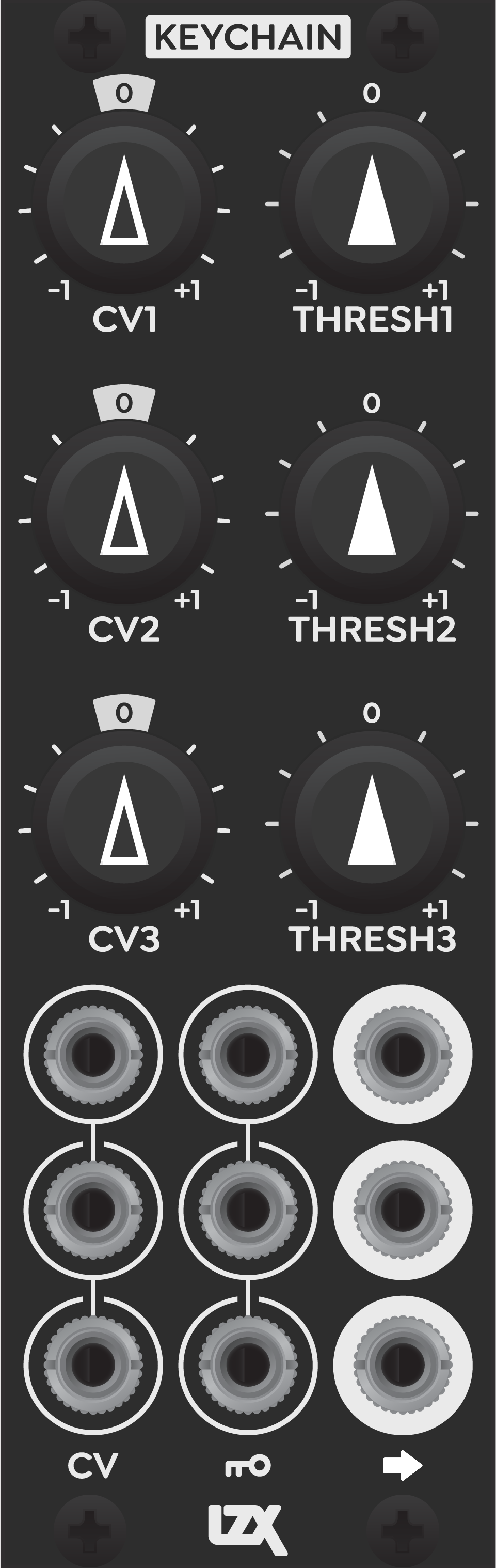
So Keychain is three independent multipliers / VCAs?
Matte is just a 6x static voltage generator with a bonus output that sums pairs of voltages? What’s the output range, -2 to +2, or just -1 to +1? The former would be more useful, and in accordance with the attenuverters on other Gen3 modules.
Oh, and if the A and B outputs are -2 to +2, does that mean the A+B outputs are potentially -4 to +4?
Color Wheel… it sounds like it’s not two independent channels. What exactly is the signal flow here?
(RGB in) + (YUV in) → (RGB out and YUV out)
Are the Stencil inputs self-normalled?
What’s up with the Stairs I/O? It can accept a luminance input or an RGB input? Are those RGB inputs weighted? If so, how does the module know whether to apply the weighting or not? Does it depend on how many inputs are active? I.e., I plug signal just into Red, not Green or Blue… Stairs passes that through without a voltage adjustment. But if I plug into all three inputs, the voltages get weighted according to their respective luminances? 0.299 R + 0.587 G + 0.114 B
And it’s outputting just a single channel at each frequency / harmonic? So, for example, if I wanted to multiply the frequency of an RGB color signal, I’d need three modules?
This all looks awesome, especially Color Wheel. @wednesdayayay comment about combining it with Sandin function generator… that is solid gold. Can’t wait to put that into practice with 2x @reverselandfill Triple Function Generators.
And finally, I know the deal is already sealed on Stairs… but what I really want is a true fractal frequency generator. Instead of fixed harmonics at powers of two, a control for the iteration frequency and a gain for the iteration intensity ratio. Both should be on attenuverters to allow positive, fractional, or negative values.
Thanks
#30 — creatorlars · 2022-06-11
dryodryo wrote:
So Keychain is three independent multipliers / VCAs?
It is three independent voltage comparators (hard key generators.)
Matte is just a 6x static voltage generator with a bonus output that sums pairs of voltages? What’s the output range, -2 to +2, or just -1 to +1? The former would be more useful, and in accordance with the attenuverters on other Gen3 modules.
It is specifically optimized as an RGB Matte source / color selector, so the knobs go from zero (0%) to 1V (100%). This is so you get the whole sweep of the pot to indicate the color channel’s brightness. If you need +/-1V bias generator, Proc is a good option there (and having the extra attenuverter/sum doesn’t hurt!)
What’s up with the Stairs I/O? It can accept a luminance input or an RGB input? Are those RGB inputs weighted? If so, how does the module know whether to apply the weighting or not? Does it depend on how many inputs are active? I.e., I plug signal just into Red, not Green or Blue… Stairs passes that through without a voltage adjustment. But if I plug into all three inputs, the voltages get weighted according to their respective luminances? 0.299 R + 0.587 G + 0.114 B
Patch into just the top jack, and it is a mono input (single cable.) Patch into all three and it is a luma input (RGB jacks are weighted as an RGB to Luma converter.) All of the inputs on FKG3 work the same way, when you are in the Luma key mode.
So, for example, if I wanted to multiply the frequency of an RGB color signal, I’d need three modules?
Correct, but you could define independent frequencies per color channel – in other words, it’s 3x single processors rather than a function that is necessarily RGB specific.
The RGB-to-Luma input makes Stairs more versatile as a single step Colorizer, that is it’s main purpose. You can recolorize an RGB source based on its luma in 8HP quickly. Keychain can fit the same “role”, but has a more digital than continuous flavor.
And finally, I know the deal is already sealed on Stairs… but what I really want is a true fractal frequency generator. Instead of fixed harmonics at powers of two, a control for the iteration frequency and a gain for the iteration intensity ratio. Both should be on attenuverters to allow positive, fractional, or negative values.
I definitely think there’s room for more complex waveshapers (modulus operators, etc.) But I think this is already what you are asking for. The powers of 2 outputs are simply “taps” from the wavefolder chain. The “Steps CV” works like a variable frequency / fractional iterations control, that responds under video rate modulation. So all the outputs contract and expand continuously in response to the Steps control.
Are the Stencil inputs self-normalled?
This is a “Luma-to-RGB-to-Luma” input, same as described above. It allows you to patch in a luma/mono value, an RGB value, or any RGB channel swap, just by the input structure. Some modules will use it as a Luma input, some modules will use it as an RGB input, some modules will use it as both (like FKG3 in Luma key mode.)
We may try something different for Stencil (like a hard key with voltage controlled Hysteresis / denoise control) since Keychain covers the “lots of keys in little space” use case well.
#31 — Robbertunist · 2022-06-11
dryodryo wrote:
So Keychain is three independent multipliers / VCAs?
Nick gave a quick breakdown of each module but then put Keychain centre stage & under the show lights during the latest stream on the LZX Twitch channel, about 7hrs ago.
#32 — creatorlars · 2022-06-11
Color Wheel… it sounds like it’s not two independent channels. What exactly is the signal flow here?>>>> (RGB in) + (YUV in) → (RGB out and YUV out)
Like so:
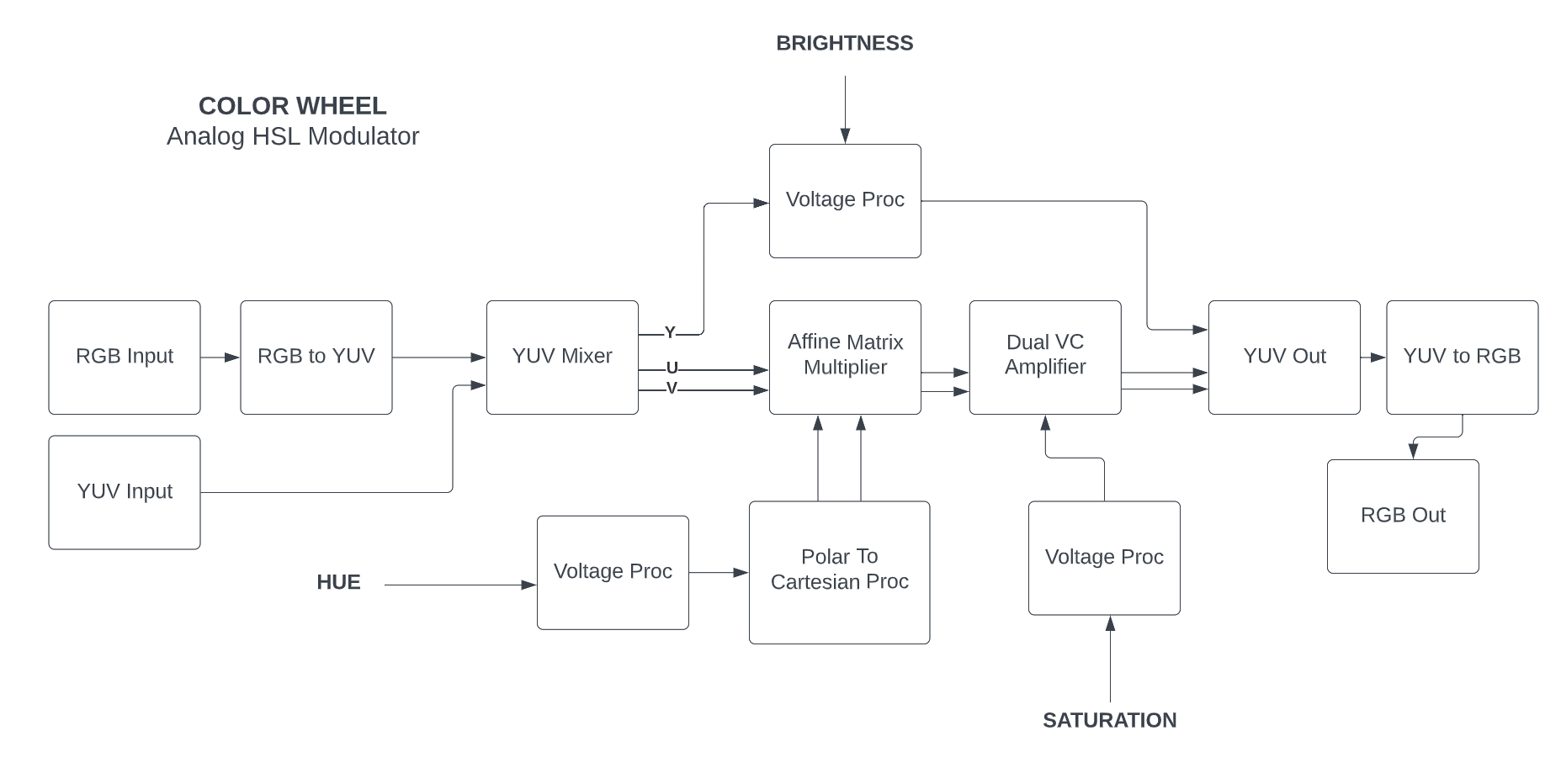
This is about as complex as the guts for a single function module should ever get, I think. It’s a good example of a function which is very usable and familiar to an artist, but that involves quite a function under the scenes. (There should be an extra VCA here, in the brightness proc, but otherwise this is a good top level look at what’s involved.) Inside the Affine/Pol2Cart blocks there are some very large circuits.
#33 — dryodryo · 2022-06-11
Thanks for answering my questions Lars… now to veer off topic once again into idea land…
creatorlars wrote:
I definitely think there’s room for more complex waveshapers (modulus operators, etc.) But I think this is already what you are asking for. The powers of 2 outputs are simply “taps” from the wavefolder chain. The “Steps CV” works like a variable frequency / fractional iterations control, that responds under video rate modulation. So all the outputs contract and expand continuously in response to the Steps control.
I think what I’m talking about is different. My inspiration is from fractal noise generation algorithms. I’m sure there’s a solid mathematical representation of this, but I am crap at that, so will have to use my linguistic skills.
-
Generator has a base frequency / first iteration
-
Multiply current frequency by some arbitrary value, usually a positive float, to create a higher frequency. This is sometimes called Lacunarity; the ratio between the frequencies of subsequent iterations.
-
Multiply current iteration amplitude by some arbitrary value … this is often called Gain. It’s the ratio between the amplitudes of subsequent iterations.
-
Add or multiply current iteration with the output of previous iterations
-
Goto 2, loop for a specified number of iterations.
If I’m not mistaken, Stair/case has a fixed frequency multiplier of 2. The artist can change the base frequency and the phase relationship between iterations.
#34 — creatorlars · 2022-06-11
dryodryo wrote:
y some arbitrary value, usually a positive float, to create a higher frequency. This is sometim
dryodryo wrote:
I think what I’m talking about is different. My inspiration is from fractal noise generation algorithms. I’m sure there’s a solid mathematical representation of this, but I am crap at that, so will have to use my linguistic skills.
-
Generator has a base frequency / first iteration>>2. > Multiply current frequency by some arbitrary value, usually a positive float, to create a higher frequency. This is sometimes called Lacunarity; the ratio between the frequencies of subsequent iterations.>>3. > Multiply current iteration amplitude by some arbitrary value … this is often called Gain. It’s the ratio between the amplitudes of subsequent iterations.>>4. > Add or multiply current iteration with the output of previous iterations>>5. > Goto 2, loop for a specified number of iterations.>>>>
Thanks for typing up the pseudocode, that makes it easy to understand!
Steps #1, #2, #3 could all be describing a patch between one or more Stairs modules and external VCA / Sum blocks.
Step #4 is more complicated. We have to answer the question of “where are we storing the value of the previous iteration”? In a digital graphics system, Step #4 is possible because we have a frame buffer, or a working buffer/variable in the CPU stack more likely. For example, the keyer feedback in Memory Palace performs this kind of fractal function when you have Mirror/Flip engaged inside the internal feedback loop. The feedback is created in this case because the foreground and background layers exist at different temporal points (1 frame is delayed!) In the analog patch, frame delay doesn’t really exist. It’s all happening more or less now.
Stairs I see as a single step ingredient. So much of the power with Staircase and what I liked about it involved doing processing between series waveshaper chains. For example, Waveshape → Gamma → Waveshape → Gamma is the op art mirror from hell – it wiggles its internal wobbles across multiple distorted perspectives. So the reason for an 8HP option is that I wanted something a little slimmer than Staircase to use as a building block in pairs and triples.
#35 — dryodryo · 2022-06-11
creatorlars wrote:
Step > #4> is more complicated. We have to answer the question of “where are we storing the value of the previous iteration”?
Sorry, maybe I’m not understanding the technical problem. Why do you need to store anything in a buffer? Can’t you just employ ordinary analog feedback? I mean, isn’t that what the wavefolder is doing in the first place? This is just adding a couple of extra bells and whistles… a variable frequency ratio and a variable gain stage.
#36 — creatorlars · 2022-06-11
dryodryo wrote:
Sorry, maybe I’m not understanding the technical problem. Why do you need to store anything in a buffer? Can’t you just employ ordinary analog feedback?
Sure you can, just grab Stairs + Proc and you’re good to go. Or Stairs + FKG3 if feedback keying is more the goal. The voltage controlled variable gain stage / frequency ratio is the control labeled “Steps.”
My point is that typically in fractal algorithms, the feedback is occurring across multiple frames – whereas in the analogue patch, we cannot peek one frame into the past. The only value accessible to us is usually whatever the last couple pixels were. So we can create very fast subpixel feedback, and this may lack the spatial properties of a fractal generator.
I mean, isn’t that what the wavefolder is doing in the first place? This is just adding a couple of extra bells and whistles… a variable frequency ratio and a variable gain stage.
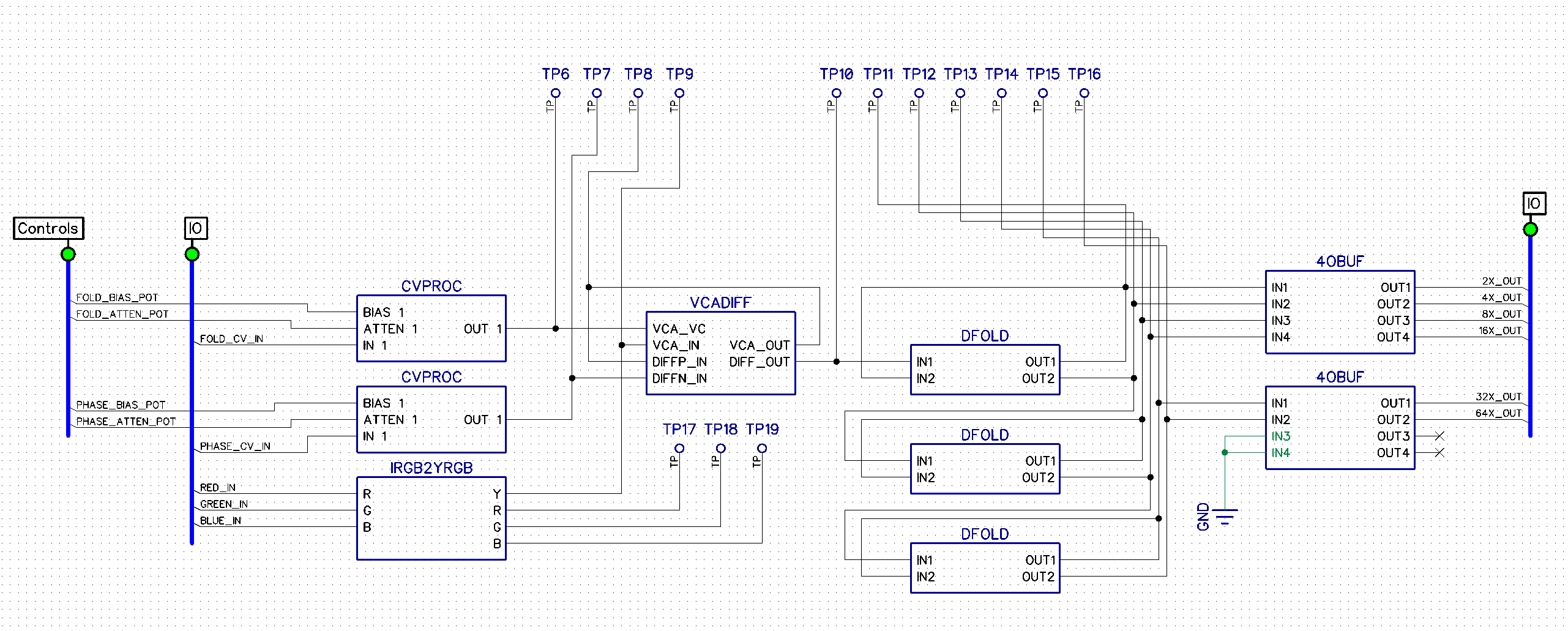
This wave shaper design is a series process through precision full-wave rectifier circuits, and doesn’t involve feedback. Variable frequency control is created by modulating the amplitude of the input signal (which is what the Steps CV does.)
Here’s the top level schematic, which is pretty readable:
#37 — creatorlars · 2022-06-11
Here is a spreedsheet model, I think you should be able to clone it and play with the values.
docs.google.comhttps://docs.google.com/spreadsheets/d/1G4HoVW2Ns5S-zPcGR6bZ2pgadjKoexPdzsb89ZJGWuU/edit?usp=sharinghttps://docs.google.com/spreadsheets/d/1G4HoVW2Ns5S-zPcGR6bZ2pgadjKoexPdzsb89ZJGWuU/edit?usp=sharingSheet1
MULTIPLIER COEFFICIENT TESTS,CONTROL KNOBS,INPUT JACKS,TESTPOINTS,OUTPUT JACKS TESTNUM,PHASE BIAS,PHASE ATTEN,FOLDS BIAS,FOLDS ATTEN,PHASE CV,FOLDS...
Link: Rectifier Calculator
#38 — analogbrainsurgeon · 2022-06-11
Would something like a shift register frame buffet be possible, where the register’s values can be variable? For example, you could envision this as a four frame buffer sample at a minimum value and then an every-120-frame buffer (or something) as a max value? Basically a shift register with control of the delay length; in the audio world a combination of E102 and Verbos Random Sampling. I realize this is easy to suggest and likely very hard to implement, but I think the possible results of a module like this would be really cool.
#39 — creatorlars · 2022-06-11
analogbrainsurgeon wrote:
Would something like a shift register frame buffet be possible, where the register’s values can be variable? For example, you could envision this as a four frame buffer at a minimum value and then a 120 frame buffer (or something) as a max value? Basically a shift register with control of the delay length; in the audio world a combination of E102 and Verbos Random Sampling. I realize this is easy to suggest and likely very hard to implement, but I think the possible results of a module like this would be really cool.
40-120 samples is possible, we do I think a 64-bit triple shift register implementation in Fortress like this for example – but if we’re talking a frame delay, that’s 349,920 samples for 1 frame of video rate delay, presuming we are wanting to access an image instead of just a single value. So FPGA/DDR3 driven systems like TBC2 and Memory Palace are much more suited for this kind of process.
Analog shift registers is definitely an area it would be cool to do more development! Russel Kramer’s Wave Comber has some neat tricks in this vein.
#40 — creatorlars · 2022-06-11
dryodryo wrote:
Oh, and if the A and B outputs are -2 to +2, does that mean the A+B outputs are potentially -4 to +4?
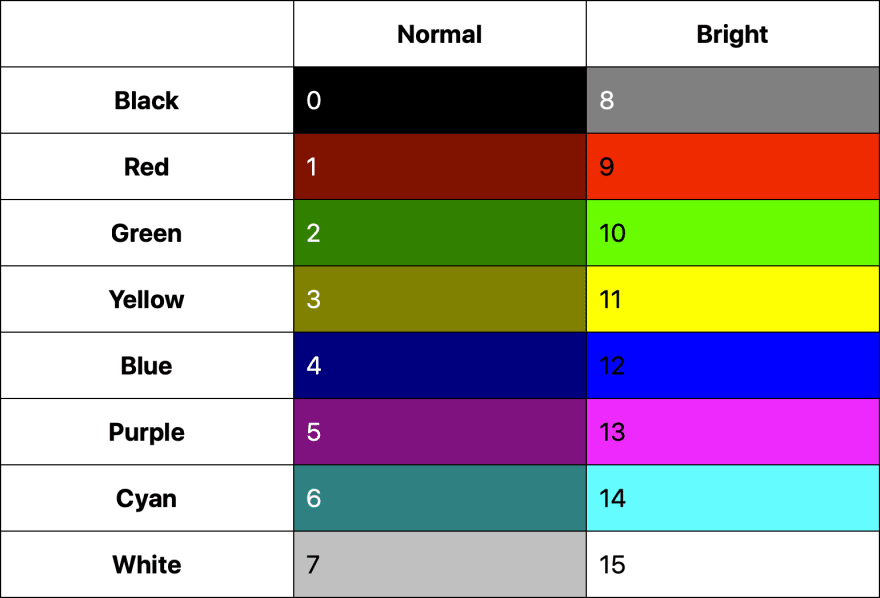
On Matte, the middle column is an average of the other two (50/50 mix.) So if Color #1 is BRIGHT RED, and Color #2 is BRIGHT GREEN, the middle column will be DARK YELLOW.
(Ansi chart for easy reference):
#41 — dryodryo · 2022-06-11
Oh, OK… it’s a rectifier and not a feedback circuit. Got it. So the whole concept of iterations doesn’t apply here. One would need to build that feedback loop via patching through external module(s).
But I’m still confused about some stuff. On the one hand you’re saying I can do this with an external patch, but on the other hand you’re saying I can’t do this because there’s no frame buffer. I still don’t see why a frame buffer is needed. There isn’t a frame buffer in the simple OSL or Bifrost implementations I’ve built. There isn’t a frame buffer in straight-up optical feedback, and that’s as fractal as can be.
And it really looks like the Stair/case Steps parameter is just changing the base frequency. If it was changing the iteration frequency, with a basic ramp input we would see that each successive “band” of luminance gets narrower. That’s not what I’m seeing in the demo video for Staircase.
#42 — creatorlars · 2022-06-11
dryodryo wrote:
But I’m still confused about some stuff. On the one hand you’re saying I can do this with an external patch, but on the other hand you’re saying I can’t do this because there’s no frame buffer. I still don’t see why a frame buffer is needed. There isn’t a frame buffer in the simple OSL or Bifrost implementations I’ve built. There isn’t a frame buffer in straight-up optical feedback, and that’s as fractal as can be.
- You can do what’s being described in your process steps inside the patch by introducing feedback with another module – you can also apply recursive gain processing by cross modulating the Steps CV input with the output taps.
- The temporal constant / memory involved is the key factor in what this output looks like. Does it look like fractal shapes on the screen? With a temporal delay of 1 frame, then yes – that’s how camera and frame buffer feedback creates fractal patterns. With a temporal delay of near nil (analog signal path), I don’t know what to expect – is it “smeared opamp grit” or something more complex? it would probably not produce any kind of 2D shape variations or pattern symmetry for example.
But maybe I don’t understand the rendering part of the algorithm. I am thinking of this in terms of processing a voltage whereas I imagine the fractal algorithm would be processing a vertex (a color value with an XY location attached). For example, the fractal algorithm’s result would iterate thru successive frames in parallel with all other pixels, producing one frame per iteration. So I am presuming in order to get recursive vertex values, we need at least one frame of memory. Unless, of course, the whole image is just 1X1 pixel.
Maybe an image of the kind of output you’d like to produce would help resolve the question.
#43 — creatorlars · 2022-06-11
dryodryo wrote:
Oh, OK… it’s a rectifier and not a feedback circuit. Got it. So the whole concept of iterations doesn’t apply here. One would need to build that feedback loop via patching through external module(s).
You could always just patch outputs back to inputs, but this works better with a gain control, so it could be done with the onboard attenuverter inputs or an external module like a mixer, keyer or proc.
#44 — creatorlars · 2022-06-11
dryodryo wrote:
And it really looks like the Stair/case Steps parameter is just changing the base frequency. If it was changing the iteration frequency, with a basic ramp input we would see that each successive “band” of luminance gets narrower. That’s not what I’m seeing in the demo video for Staircase.
You could get what you’re describing by patching the input ramp to both Steps CV and the primary Luma input at the same time, and playing with the CV attenuator until the sweep looks like what you want.
#45 — dryodryo · 2022-06-11
Sorry to take you down another rabbit hole! I keep hijacking your threads.
Thank you, I think I’m finally seeing how this would work, multing the signal into the Steps CV input to modulate the base frequency. Or otherwise plugging some version of the input signal into Steps CV. E.g. running it through a gamma corrector like Syntonie VU005.
Exciting stuff, thank you again!
#46 — creatorlars · 2022-06-11
dryodryo wrote:
Thank you, I think I’m finally seeing how this would work, multing the signal into the Steps CV input to modulate the base frequency. Or otherwise plugging some version of the input signal into Steps CV. E.g. running it through a gamma corrector like Syntonie VU005.
Yeah, gamma, log, expo, anything slope processor related, would be an interesting thing to patch into the feedback path.
#47 — dryodryo · 2022-06-11
Right, Arch or DSG3 would work there… but I like the Syntonie waveshaper because it’s got a variable control.
#48 — creatorlars · 2022-06-11
Right, Arch or DSG3 would work there… but I like the Syntonie waveshaper because it’s got a variable control.
Yes, all good options – but variable control definitely in the feedback case. Another Stairs in the feedback path is always an option too. Give that some quadrature LFO modulation and watch it go.
#49 — dryodryo · 2022-06-11
I think you mean Baja modulation
#50 — dryodryo · 2022-06-11
@creatorlars Regarding Matte… having slept on this, I realized that you are right, as usual. Voltage range of 0 to 1 makes way more sense for a dedicated color picker. It gives the full range of mechanical precision. I was planning to use 4x @Fox Foxing Hour Access and 3x FKG3 to roll my own EAB colorizer. But Access isn’t optimized for that, since its output range is -1 to +1. One can only use the mechanical range from 12:00 to 5:00 for legit RGB values. It’s better to have the full mechanical range of 7:00 to 5:00. If you want to subtract colors, that’s what the SMX3 input attenuverters are for.
Color picking is a critical feature for me. Video synthesis artwork has always suffered from limited color palettes simply due to the design / limitations of the tools. Any time an artist uncritically ends up with RGB primaries, or even worse, secondaries, it makes the angels weep. The precision of Matte should help with that problem.
Hopefully you can make the price point competitive with some of the options out there for static voltage generation. I think that’s doable despite the more expensive power assembly and whatever high end components. E.g. 2x Access = $318 … and obviously that’s much more than just a static voltage generator, so it’s not a direct comparison. But you see where I’m going with this. An 8HP Matte should land significantly under $300 considering that much more baroque 12HP Gen3 modules are $399 standard.
Thanks
#51 — creatorlars · 2022-06-11
dryodryo wrote:
An 8HP Matte should land significantly under $300
Yes, I would expect $199 at the most. Matte is intentionally a lower cost system builder module.
The first five Gen3 modules all have triple stack PCB assemblies (control board, core board, power supply board.) Matte and the other new ones here aside from Color Wheel are double stack PCB assemblies (just control board + power supply board.)
Triple stack modules I would expect to range $30 - $40 per HP.
Dual stack modules would be more like $20 - $30 per HP.
We may shift some pricing soon due to costs being crazy right now, but that would be a percentage overall change rather than module specific.
#52 — analogbrainsurgeon · 2022-06-11
Will we see a triple filter soon? I’m imagining an RGB Curtain with independent filters per color channel.
#53 — creatorlars · 2022-06-11
I could see a triple 8HP VC differentiator (high pass filter, fixed to video rate response) being very handy. A good sculpting tool for triple keys as well.
I think Fox is working on a triple RGB filter. I’m not sure if that is triple or single cutoff – there are definitely advantages to both approaches. Filters will shift the image around, so if you want to filter RGB without creating color alignment shift, you need three filters calibrated to perform identically with single controls.
We do have a new dual filter/texture source planned for 12HP (previously teased as DWF3.) This one is actually based on our OTA VCO core on DWO3, so it’s a new design, but will also serve as a War of the Ants update (“noise” will be one of the filter range options.)
A luma enhancer, but with RGB IO option is something I’d like to do for sure – that would be the most direct follow up to Curtain, with separate main parameters for cutoff and depth. It would focus specifically on brightening/darkening the edges of an RGB source, kind of a temporal Dodge/Burn tool.
Some of the most exciting FPGA based stuff we haven’t attempted yet involves spatial and temporal filters – something that’s not possible without frame buffers and memory.
#54 — Fox · 2022-06-12
creatorlars wrote:
I think Fox is working on a triple RGB filter. I’m not sure if that is triple or single cutoff – there are definitely advantages to both approaches.
I am working on a filter, yes!
Not to steal from the thread but my filter is a single state variable filter with High- and Low-Pass outputs in 4HP based on an available example in the LT1228 datasheet. For RGB, three modules are needed.
creatorlars wrote:
Filters will shift the image around, so if you want to filter RGB without creating color alignment shift, you need three filters calibrated to perform identically with single controls.
Three separate filters used in parallel will not share the same voltage-to-current source, true. Alignment shift can be observed but using different pairs of matched transistors on each module has proven to be quite predictable.
#55 — jwsmithwick1 · 2022-06-12
@creatorlars, side question, would it be possible to add a dip switch to the Matte to make the “A+B” out A-B?
Additionally could switches be added to the mixer on the sum/dist module so that one or two of the RGB inputs to make them negative? What I’m thinking is basically like the mixer section of bridge, expanded to the the ARGB format of the sum/dist circuit?
#56 — creatorlars · 2022-06-12
jwsmithwick1 wrote:
What I’m thinking is basically like the mixer section of bridge, expanded to the the ARGB format of the sum/dist circuit?
Sum/Dist I think needs to stay very straightforward, as it’s purpose is more about signal routing for parallel signal paths, where you often need to mult a source multiple places, and then have a straightforward way to get a unity sum of the results from multiple processors.
For Matte, if you have an A-B option there, it is possible for the middle column to contain colors that are below black (for example, if A is black and B is white, A-B would just clip at black, rendering it identical to A.) This isn’t necessarily a bad thing, but it does mean that it introduces a rule to remember if you’re using it specifically as a color selector.
I think in both cases, what you probably want is Proc! That’s a very efficient way to do a variable subtracting/differential mix – and it also doubles as a general purpose triple gain control or triple bias generator. SMX3 is also a good option for variable additive/subtractive mixes.
I see the appeal of a fully patchable differential amp though, maybe there’s a Diff/Multiplier in the same format as Sum/Dist at some point?
#57 — creatorlars · 2022-06-12
Not to steal from the thread but my filter is a single state variable filter with High- and Low-Pass outputs in 4HP based on an available example in the LT1228 datasheet. For RGB, three modules are needed.
Awesome! This is what the Triple Video Multimode Filter was based on, too. I had to trim all the inputs to get matched response curve, but it worked nicely. Curtain is a VC differentiator rather than multimode, but also uses an LT1228.
Fox wrote:
Three separate filters used in parallel will not share the same voltage-to-current source, true. Alignment shift can be observed but using different pairs of matched transistors on each module has proven to be quite predictable.
Yes, it is certainly possible to dial it in. I guess my point is that I could see good reasons for both topologies as valid function blocks / module concepts (triple filter vs three filters.)
#58 — jwsmithwick1 · 2022-06-12
Word, that makes sense. I have multiple passages. Big fan of the mighty proc!
#59 — dryodryo · 2022-06-12
creatorlars wrote:
maybe there’s a Diff/Multiplier in the same format as Sum/Dist at some point
You know I want that. Actually I want all arithmetic operations. In combo with Matte you’ve got basic algebra. The division operation would be a gain amplifier since you’re only feeding it values from zero to one.
For that matter I hope there’s a plan for updated analog logic. I do have 3x Arch but I know I’m going to need more.
Thanks!
#60 — analogbrainsurgeon · 2022-06-12
Thanks for the replies guys! I guess looking for a reasonably priced third Curtain is my best bet for now; being able to independently shift each color around and mess with the alignment of each channel is exactly what I’m after.
#61 — rempesm · 2022-06-12
dryodryo wrote:
For that matter I hope there’s a plan for updated analog logic. I do have 3x Arch but I know I’m going to need more.
This is what DSG-3 is.
#62 — nerdware · 2022-06-12
I’m a big user of bandpass filters. I like the LP and HP filters too, but I find BP most useful in my video feedback patches.
#63 — dryodryo · 2022-06-12
@rempesm Not entirely… DSG3 doesn’t have all of the logic functions of Arch. It’s missing the Intersection and Clip modes.
Plus it would be great to have more compositing modes. Lars has written about this, I’m sure it will come in some form.
#65 — cata · 2022-06-13
dang that sounds sick!
#66 — creatorlars · 2022-06-13
Part of our goal with this series is to offer not just different function groups, but different control arrangements of similar function groups – for example, a 3x 8HP logic could process RGB in 24HP, but an RGB logic operator module could perhaps do the same in 1x 12HP module. Of course, this isn’t just an exercise in exhausting all possibilities, the idea is to grow it organically around system concepts.
It would be nice to provide enough options such that the user has a lot of control over their system build. In a part of your synth focused on granular pattern synthesis you might prefer quads or triples of single function modules, even if the real estate is larger – whereas in line with an RGB output path you may prefer the multimodal nature of an analog graphics operator (like an HSL modulator or Luma keyer.)
DSG3 offers some analog logic blocks and supporting waveform generation in the most compact/dense way I could think of. It’s highly suited for 3-4 module mini systems or being part of a voice in a “polyphonic graphics” arrangement, where each voice needs its own core ramp/spatial pattern source. If your video synth only has one module dealing with ramps, curves and analog logic (the ingredients you need to make 2D shapes) – or if you prefer building in voices / independent shape generator sections – DSG3 is a great fit.
But analog logic is an ingredient, not a recipe, so there are many other places it’s likely to show up in future modules – I think the two most likely would be an RGB blending module and a piecemeal function bank (although there would still be a lot to decide regarding size and combination of functions – the Sum/Dist style patchable quads layout could work for example.)
One approach might be to offer some kind of 8HP multimodal super function. Just a dual in, single out function, but the full array of operators (mix, multiply, analog logic, soft key, hard key) as modes on a rotary switch. With modules like this, the cost-per-function and hp-per-function ratios go way up, but it would be incredibly versatile, especially in the case you had three for RGB processing.
#68 — dryodryo · 2022-06-15
creatorlars wrote:
One approach might be to offer some kind of 8HP multimodal super function. Just a dual in, single out function, but the full array of operators
+1000
But there are always many ways to skin a cat, and embedding analog logic in higher level modules is great, as well. Excited to get my DSG3 and see what crazy stuff it can do. Might need to get another one at some point for full RGB processing. First I need some hands on with just the one module and see how far I can take it.
Loving Gen3, I’ve said this before but 10+ years of constant development and production really shows here. LZX is by far the most mature video synth ecosystem the world has seen.
#69 — analogbrainsurgeon · 2022-06-17
So thinking more about my shift register question/idea I realized that TBC2 or Memory Palace may allow for the “frame sampling” that I imagined, but another buffer after would be needed to allow for the ASR effect. An example of my idea would be taking a gif, or any kind of stop motion or series of images within a bank, and sending a sequnce of them through an ASR so there would be an image delay (not technically a frame delay or sample delay, just another image, could be from a sequnce that makes sense like motion, or not), then being able to recall “delayed” images from the ASR’s buffer at another point. This shift register behavior would help to coordinate other modulation sources so, for example, selecting an image from the buffer would also send other delayed signals out of its channel’s outputs to adjust other module’s parameters like oscillator frequency or filter cutoff. I fully realize there’s very little analog about what I’ve just described, haha, but I feel like describing it as an analog shift register helps get the idea across.
#70 — creatorlars · 2022-06-19
analogbrainsurgeon wrote:
This shift register behavior would help to coordinate other modulation sources so, for example, selecting an image from the buffer would also send other delayed signals out of its channel’s outputs to adjust other module’s parameters like oscillator frequency or filter cutoff.
What you’re describing is pretty similar to how the Memory Palace’s frame delay already works – images are loaded into a sequence, and the delay can arbitrarily access any frame in that sequence. What’s different about this suggestion though is the idea of delaying the modulation state of each image, and giving those persistence as well! That could be very interesting.
#71 — analogbrainsurgeon · 2022-06-26
Sensory translator for incoming video… I’ll expand later.
#72 — wednesdayayay · 2022-06-26
I’ve wanted a RGB in and R%G%B% / luma Black% white% output module for a while now. I’ve got a version I made in touch designer that is a super fun modulator.
Getting hardware CV sources of the percentage of a color in the frame would be pretty rad.
of course once you have those CV sources then you add all the S&H, slews and switches…
#73 — wednesdayayay · 2022-06-26
I would also love to see a bus channel module
something with 2 or 3 sets of RGB inputs and a single RGB output
realistically 4 seems like a little bit much for smaller systems…maybe
latching selection switches above or below each of the input channels
maybe CV control over the selection but not totally necessary
hard switching not fading would be totally fine
however fading would certainly bring a new twist to the idea
a couple bus channels and a FKG3 would be the making for a really fun and familiar mixer section.
if we wanted to get a little silly
a matrix switcher
9 inputs and 3 outputs
the outputs could each have a rotary encoder to select which of the 9 inputs it uses.
that way you could select a full RGB input channel or mix and match from separate RGB sources. You could also just patch up a bunch of different outputs that aren’t necessarily a full RGB voice (ramps oscillators shapes keys…)
like a hard switching cousin of the SMX3
sometimes it is good to flip around the color channels in a RGB voice without having to unpatch.
so if you had a camera plugged into TBC2 but instead of RGB you wanted to look at GBR or BGR or any of the possible full voice combinations
RGB, RBG, GBR, GRB, BRG, BGR
you could do that without all the patching and unpatching
#75 — Fox · 2022-06-26
wednesdayayay wrote:
any of the possible full voice combinations>>>> RGB, RBG, GBR, GRB, BRG, BGR>>>> you could do that without all the patching and unpatching
It's more likely than you think. https://www.youtube.com/watch?v=MDGgnu3qO-s https://www.youtube.com/watch?v=zOkMvIhXNbM
#76 — Dr_Rek · 2022-06-29
Got my Stairs order in

#78 — joem · 2022-06-30
I don’t think there’s been a Stairs “restock”. I’m pretty sure what was for sale today was just a tiny first-ever batch (possibly what they could assemble from leftovers of their final prototype batch?).
I heard about it from an Instagram post (or maybe a IG story?) where it explicitly said “limited stock”. And LZX have repeatedly mentioned that they’re planning to have things either not running out of stock or only have brief absences in the future, so I wouldn’t worry too much if you missed it. They’ll definitely be doing more. What was up on the site today was just the beginning. I would try not to view it as something to be frustrated by missing, but as a slow start to general availability for the new Stairs module.
#80 — vhsdestroyer · 2022-06-30
Reminds me of Yellow Jacket, Visionary (April 1st), and Marble Index drops. I’m curious how many times daily a person might need to look at one of these platforms to catch this kind of stuff. 1, 2, 3, 5, 10? This release model rewards luck, obsession, or both.
Maybe we should use the #news#news this thread is tagged in for similar announcements in the future.
#81 — sean · 2022-06-30
Given that the status update Lars posted on the forum here the other day was very similar to the mailing list email that was sent out today, I took it as maybe just a simple editorial mistake that the latter still said the modules would be releasing “this week” — when they were, from what I could tell, already available on the site at the time it was sent (or put up shortly thereafter).
#82 — Z0NK0UT · 2022-06-30
This is a very good point. In the future I will make sure to make an explicit announcement here on the forum. I assumed (incorrectly) that the email list (nearly 3k subscribers) and Instagram (nearly 9k followers) would catch everybody. I updated the newsletter link on the forum, but did not post explicitly about the new inventory. And, as @sean noted, even the newsletter (which was written before knowing exactly which modules would be ready to ship) did not specifically state module availability. Apologies infinite for this oversight.
@joem is correct–there will be more of these modules. Lots more! They will be in production for long enough that everyone will have a chance to purchase several of each module. We were only able to squeeze in 30 each of four different modules while the production team was waiting on the development team this week. It was inevitable that we would not be able to meet demand with initial quantities, thus disappointing most–especially those interested in Stairs (which sold out in less than an hour).
Sorry for the tease! The wait for a restock won’t be long.
#85 — rempesm · 2022-06-30
I check the forum pretty regularly and had no idea about the newsletter thread. It might seem a little messy but just replying to that thread with a new link would be way more visible for the default settings on the forum.
I had similar issues with the newsletter coming through on my email for awhile. Just had to sign up again but I don’t know what switch actually got flipped for it to start working reliably since I didn’t sign up any differently from the first time around.
#86 — Z0NK0UT · 2022-06-30
OK. I will try making a new post, instead of editing.
#87 — sean · 2022-06-30
rempesm wrote:
I had similar issues with the newsletter coming through on my email for awhile. Just had to sign up again but I don’t know what switch actually got flipped for it to start working reliably since I didn’t sign up any differently from the first time around.
I had the same experience.
#88 — wednesdayayay · 2022-06-30
my LZX emails in gmail end up in the promotions category at this point
#89 — nerdware · 2022-06-30
The only availability that matters to me is my local distributer. I will not be ordering direct. While I appreciate the excitement here over the recent new modules, I have no idea when I might see any that I can buy. However, I’m pleased to see progress and happy people.
#90 — Z0NK0UT · 2022-06-30
There will probably be some more inventory hitting the site in an hour or so.
Should be big enough utility module production runs to send inventory to dealers after ESG3, DSG3, and TBC2 ship in the next week or two.
#91 — brownshoesonly · 2022-06-30
4:00PM Pacific Time I’ll have numbers and post stock.
#93 — joem · 2022-07-01
Not only that, but 2 hours later and they’re still in stock, apparently.
#94 — analogbrainsurgeon · 2022-07-01
Of the four new smaller modules, Stairs was the most interesting and being able to use it on an rgb signal is something i couldn’t do before, so I’m in!
#95 — destroythings · 2022-07-01
I was a bit confused about the RGB input on Stairs. Does it output a RGB signal or only Luma?
#96 — Z0NK0UT · 2022-07-01
The RGB inputs are there to maintain the Gen3 RGB workflow, but Stairs mixes down to luma in order to shape/multiply. The resulting outputs can be patched back into the RGB workflow. If you have the time, check out the last Twitch stream to see Nick patching with Stairs: Twitch
We’ll have a shorter “3 Patches” demo coming soon.
#97 — nerdware · 2022-07-01
Alternately, patch Stairs into a matrix mixer to get whatever blending you want. I like using a YUV->RGB conversion for this kind of thing, but using Staircase. In fact, I was doing exactly that just an hour ago.
#99 — analogbrainsurgeon · 2022-07-01
There went my afternoon.
#100 — rempesm · 2022-07-01
There really is only one internal input into Stairs’ frequency multiplier core. The RGB inputs are essentially a 3 input weighted mixer. They are following the Rec. 601 standard of approximating the relative brightness of a color image. Simplest terms, Green represents the largest part of the mix, then Red, then Blue. It’s actually 0.299 for Red (~one third), 0.587 (~half) for Green , 0.114 (~one tenth) for Blue.
This RGB to Luma function is integrated into other Gen3 modules, notably FKG-3, and exists as a standalone module as @Fox ’s Luma module.


https://foxinghour.com/products/luma-rgb-to-y-greyscale-converterLUMA converts an RGB image into the greyscale equivalent Y. Y is the specially weighted mix of R, G and B that accurately represents the luminance intensities of each color as they are perceived by the human eye according to the “International...
Price: USD 22.00
Link: LUMA - RGB to Y Greyscale Converter
#101 — Robbertunist · 2022-07-04
7pip wrote:
Stairs makes an appearance at:
-
00h33m11s>>>>
& also from 2:41:00 where Nick directly compares the outputs of a Stairs & Staircase for a few minutes using a DWO3 & then brings TBC2 into the patch. This all lasts about 14 minutes.
#102 — mrfang · 2022-07-20
“after ESG3, DSG3, and TBC2 ship in the next week or two.”

#103 — Z0NK0UT · 2022-07-21
We’re trying! And remain very very close. Here’s Lars’s most recent update, in case you missed it:
It’s been a bit of a long week for us here – initial batch testing of 9 units of ESG3 on Monday uncovered a new clock crystal tolerance related issue. A couple units were outside the other unit’s lock ranges at their resting frequencies. We’ve got this resolved now it appears – but we are going to be testing for another day or two to be sure, before we can say we are done. Some of us are also out of office or sick right now, so I don’t think there will be any ESG3 going out this or next week. …>
#104 — DaydreamDevices · 2022-07-22
All this time I thought I was in an Acid cult… did I end up in a crystal cult? Thats not the future I had planned for myself
#105 — Dr_Rek · 2022-07-22
“Ships when it’s ready” should be the release date messaging. I’ve been in a holding pattern to send my memory palaces back for repair of the shaky issues they’ve had since I got them in early 2020, until my Chromagnon arrives… maybe this year


#106 — monads · 2022-07-24
Well least still on track for this year!

I’m hoping August/September 2022 timeframe.
#107 — Robbertunist · 2023-03-04
creatorlars wrote:
Color Wheel uses the ART3 core assembly, as does Chromagnon – we opted for Color Wheel’s implementation first, as it is more closely related to the Chromagnon’s implementation for it. So the affine module will come after.
Ahhh, I’ve just been quickly looking through here @creatorlars regarding rotation modules & hadn’t realised that there may be two due this year, one to work with Swatch for the Colour Wheel/Hue Rotation effect & the ART3 that is somewhat a Gen3 version of Navigator. Is this still the plan?
It’s really nice to see Angles been announced & available on the shop site yesterday
Update:
I’ve just seen the following reply
creatorlars wrote:
It’s the same core board as Color Wheel (which is also a Chromagnon sub assembly), so the affine function is still coming – the Color Wheel implementation allows us to test the assembly’s performance more closely as it relates to Chromagnon itself, which is our primary focus.
#108 — creatorlars · 2023-03-05
Robbertunist wrote:
Is this still the plan?
All module design plans are constantly morphing and subject to change until we have something ready to release. I’m not sure if any of the rotator modules will come out before Chromagnon or not. But right now the plan is for the rotator to work equally for vector usage (like Navigator) and for chroma usage (in combo with Swatch, for Color Wheel functionality.)
#109 — Dr_Rek · 2023-06-05
Did Stencil become Ribbons? Or still on the way?